
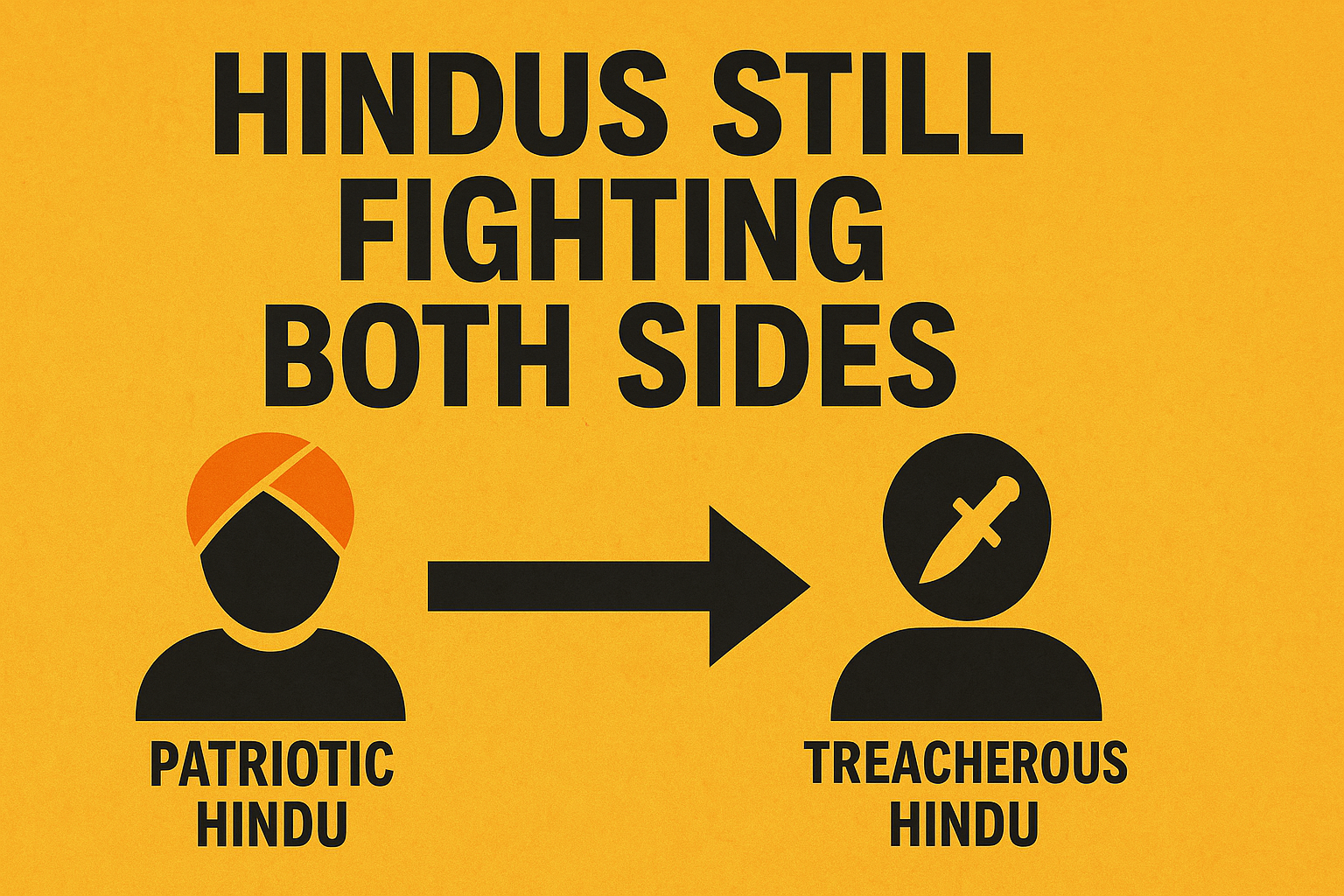
“Still Fighting on Both Sides”: Historical Echoes of Hindu Disunity Resurface in India’s Waqf Bill Debate
A hauntingly familiar pattern of internal Hindu division is once again in the spotlight as parallels are drawn between the historic Battle of Haldighati and the modern-day Indian Parliament’s vote on the Waqf Bill. The ongoing controversy over land rights and religious favoritism under Waqf laws has sparked fresh debates, not just about legality, but about cultural memory and national loyalty.
In the late 1500s, the fierce Battle of Haldighati saw two major Rajput forces clash—both composed predominantly of Hindu warriors. On one side stood Maharana Pratap, a symbol of resistance and sovereignty, and on the other, Akbar’s generals Raja Man Singh and Raja Loonkaran, also Hindu Rajputs who fought under the Mughal banner.
According to Abdul Qadir Badauni, a devout Sunni Muslim and a court historian in Akbar’s court, the battlefield was a visual puzzle. In his Arabic chronicle Muntakhab-ut-Tawarikh, later translated into English in the 18th century, he describes the dilemma faced by Akbar’s general Abul Fazl, who was confused by the sight of Hindu Rajputs on both sides wearing identical saffron turbans. Unsure who was friend or foe, Abul Fazl asked Badauni how to distinguish the two.
Badauni’s chilling response:
“Fire arrows. Swing swords. Throw spears. It doesn’t matter who dies—on either side, it is the infidel. Victory belongs to Islam. And if we lose, we can still tell Allah we killed the unbelievers.”
This historical account stands as a brutal reminder of how Hindus were weaponized against each other, often unknowingly fighting battles that advanced someone else’s religious or political cause.
Fast forward to today, the Indian Parliament saw a strikingly similar divide during the vote on the controversial Waqf Bill. Out of 288 members who opposed the bill, only 24 were Muslim MPs—the remaining 208 were Hindus. These Hindu lawmakers, knowingly or not, stood behind a law many believe encourages unchecked religious land encroachment and discriminatory legal privilege.
The irony is not lost on political analysts and historians alike. The very people whose ancestors fought valiantly to protect their land and faith are now allegedly enabling policies that, critics claim, facilitate religious conversion and land takeover through legislative means.
This juxtaposition of past and present leaves many asking:
Have we learned anything from history—or are we still fighting on both sides?
