
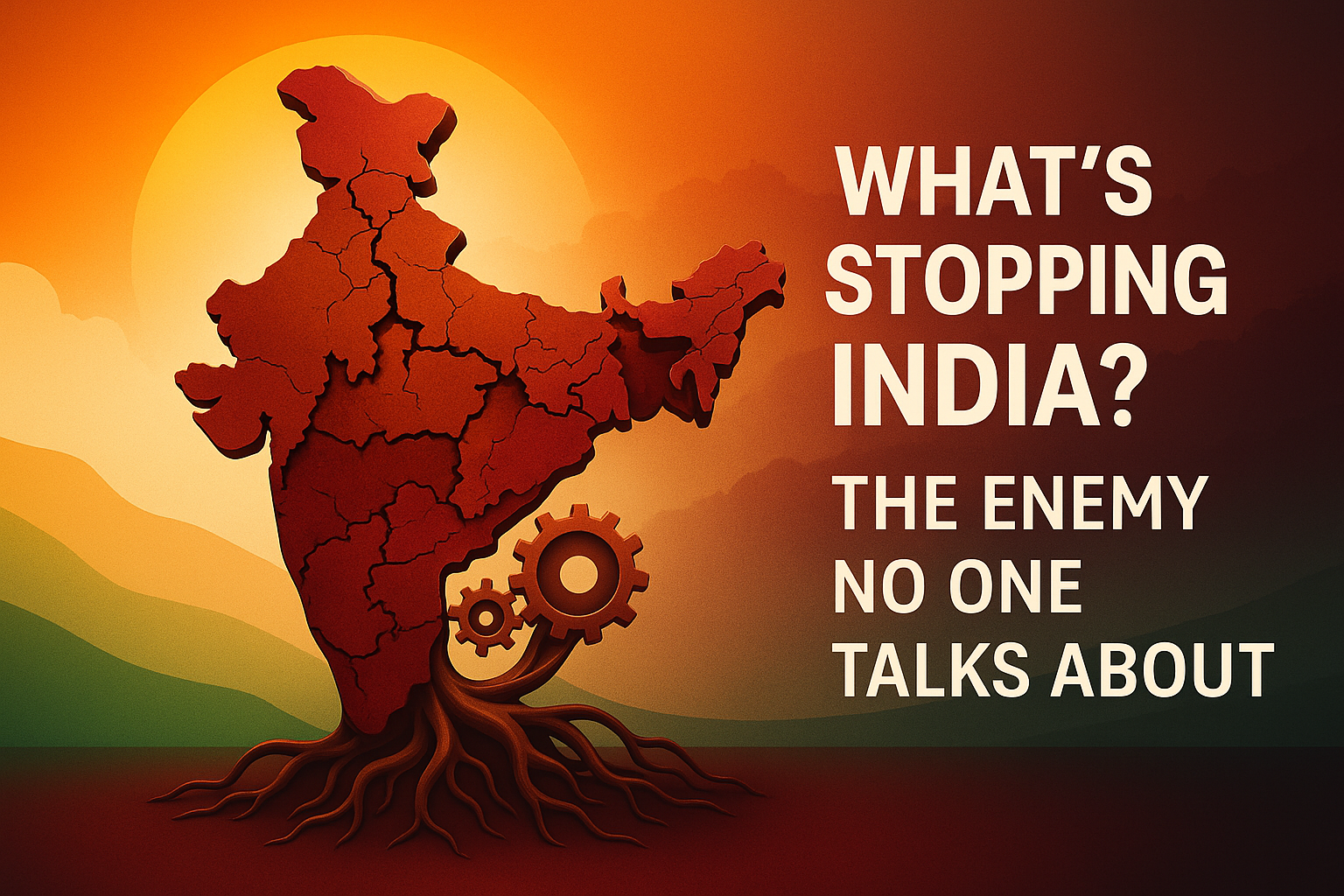
India’s greatest challenge isn’t war or rivals—it’s what’s rotting from within. Explore the real reasons stopping Bharat’s rise—and how we can change it.
India—the land of sages, startups, satellites, and spiritual strength—stands at the threshold of greatness. With the world’s youngest population, a surging economy, unmatched digital reach, and global recognition, the dream of Viksit Bharat by 2047 doesn’t feel like fantasy. It feels inevitable.
Yet something lags. Something holds us back—not external wars, not foreign adversaries, not sanctions—but something far more dangerous because it’s invisible, internal, and ignored. It’s the enemy within.
This article isn’t about fear-mongering. It’s a deep, honest reflection on what really obstructs India’s growth, peace, and global leadership. And more importantly, what we, as citizens, can do about it.
India at a Crossroads: Glory Within Reach
2025 India is dynamic, defiant, and determined. We’re launching space missions, breaking investment records, exporting digital talent, and redefining global narratives. Our democracy remains messy but alive. Our culture remains rooted but inclusive.
We’ve got:
- A $4 trillion economy
- 800 million internet users
- 1.4 billion citizens with voting rights
- Spiritual traditions that transcend generations
So what’s missing? Why is our Global Happiness Index dismal? Why is internal migration still a survival tactic instead of an economic aspiration? Why do villages remain without clean water while billion-dollar startups sell quick commerce?
Because we’re at war with ourselves, not metaphorically, but systemically. India’s biggest threat isn’t Pakistan or propaganda. It’s what lies in our institutions, our ideologies, and sadly, often, our indifference.
Defining the “Enemy Within”
The “enemy” isn’t a person. It’s a pattern. It’s corruption without shame, politics without principle, development without depth, and nationalism without action.
The internal enemy is:
- Corruption that leaks public wealth at every level
- Polarised politics where elections matter more than education
- Caste and communal hate weaponised for vote banks
- Bureaucratic bottlenecks that stall even sincere reforms
- Social apathy—a generation watching reels instead of reality
- Narrative colonisation—a media-academia complex that mocks tradition and valorises victimhood
This is a war of attrition. And it doesn’t make noise. It doesn’t explode on borders. It erodes from within.
Political Paralysis: When Power Blocks Progress
Let’s be honest: India doesn’t suffer from a lack of ideas. It suffers from over-politicisation and underperformance.
Every meaningful reform—from agriculture to UCC to judicial accountability—is either blocked by:
- Partisan resistance
- Vested interest lobbies
- Outdated ideological baggage
Debates become noise. Parliament becomes a stage. National priorities take a backseat to election optics.
Worse, every crisis becomes a chance to score points, not solve problems. Be it COVID management, budget sessions, or border policy, governance becomes theatre. And the real losers? The citizens.
Imagine the momentum lost in pushing a simple bill. The hours wasted in walkouts. The dreams are delayed while manifestos are being rewritten for Twitter trends.
This is what political immaturity looks like—and no superpower can grow with petty politics at its core.
Corruption and Cronyism: The Silent Killers of Growth
India’s GDP doesn’t suffer from a lack of innovation. It suffers from leakage. From the grassroots to high offices, bribes, favouritism, and backdoor dealings act as a cancer within our economic system.
- Contracts go to cronies
- Loans go into default
- Promotions go to sycophants
- Jobs go to relatives, not merit
This is the India many live in but no one posts about.
Did you know?
- India loses an estimated Rs 6 lakh crore annually to corruption.
- Over 70% of citizens still pay some form of bribe for basic services.
Now imagine that money invested in rural education, healthcare, start-up grants, and AI labs. We’d race ahead.
But corruption isn’t just about money—it’s about morale. It sends a message to youth: “merit doesn’t matter, jugaad does.”
And that message kills a nation slowly.
Communal Divide and Cultural Amnesia: A Fractured Soul
India has always thrived on diversity—Hindus, Muslims, Sikhs, Christians, Parsis, Jains, and more. But political exploitation of identity has turned our diversity into a battleground.
Temples vs mosques. Castes vs sub-castes. North vs South. We keep drawing lines where none existed.
Meanwhile, the cultural soul of Bharat is being systematically undermined by:
- Academic distortion of history
- Media hostility toward Dharma
- Social media narratives mocking traditions as “superstitions”
This isn’t innocent ignorance. It’s intentional erasure—a slow hollowing of pride, identity, and unity.
And what’s worse? The silence of the masses. Apathy is the real victory of this enemy.
Judicial Backlogs and Bureaucratic Bottlenecks: Justice Delayed, Growth Denied
India’s judicial system is a paradox—it commands respect, yet it crawls at a pace that drains justice of meaning.
As of 2025:
- Over 5 crore cases are pending across courts
- Many undertrials have been imprisoned longer than the sentence for their alleged crime
- Land dispute resolutions take 10+ years in many cases
- Whistleblowers face endless procedural hell
A nation cannot grow if its citizens don’t trust its institutions.
Simultaneously, the bureaucracy—originally designed for service—now functions as a fortress. Reforms, welfare, and developmental projects all get slowed down by:
- Red tape
- Procedural paralysis
- Fear of accountability
- Endless file-pushing
This combination of judicial delay and bureaucratic indifference is a silent suppressant of our national engine. We don’t lack laws—we lack their timely, honest application.
If ease of doing business or delivery of justice takes years, dreams die in files—and with them, India’s momentum.
Media Manipulation and the Misuse of Narrative
In an age where perception shapes reality, India’s narrative ecosystem is one of its weakest links.
The media today isn’t informing—it’s influencing. And often, it’s:
- Biased
- Bought
- Broken by ideological warfare
We’ve allowed external funding, politically driven editorial lines, and clickbait sensationalism to replace truth. Investigative journalism has shrunk. Trial by media has exploded. Newsrooms have become digital battlefields where facts are shaped to suit tribal loyalties.
Add to this, social media influencers—often unqualified, unverified, and unaccountable—who spread everything from caste hatred to anti-national conspiracies with viral ease.
Even academia hasn’t been spared. Universities once meant for debate and discovery have turned into breeding grounds for ideological radicalism, where India is viewed as a problem, not a potential.
This narrative sabotage, left unchecked, will destroy India not by invasion, but by confusion.
Economic Apathy and Talent Drain: When Potential Goes Unused
India has brilliant minds, but not all stay back to build Bharat. Why?
Because the system repels merit, rewards mediocrity, and often stifles creativity under outdated norms.
Every year:
- Over 2.5 lakh students migrate for education abroad
- 80% of funded Indian start-ups register outside India
- Our best scientists and AI engineers work in foreign labs
- Our skilled farmers remain at the mercy of middlemen
We aren’t short on intelligence—we’re short on incentives.
This talent drain and resource misallocation isn’t just an economic loss. It’s a betrayal of our own people.
India must become a nation where:
- The best minds stay
- The rural economy thrives
- Skilling gets priority over slogans
- Innovation receives investment, not red tape
Until then, we’ll keep celebrating symbolic wins while losing systemic battles.
Apathy and Indifference: The Most Dangerous Enemy
Most Indians are not corrupt politicians, media manipulators, or bureaucratic roadblocks.
They are well-meaning citizens who are just… silent.
Silence when:
- Bribes are paid
- Bigotry is preached
- Fake news circulates
- Merit is bypassed
- Dharma is mocked
It’s this indifference that allows internal enemies to thrive.
We forward WhatsApp quotes on nationalism, but won’t vote.
We post patriotic reels but ignore civic rules.
We demand accountability, but don’t participate in building solutions.
India’s greatest threat might not be malicious intent—it’s national apathy disguised as comfort.
What We Must Do: Rebuilding India from the Inside
There is hope. Always.
Every era has had internal challenges—what matters is how the society responds.
Here’s how India can begin its internal transformation:
Educate, Don’t Indoctrinate
Make civic education mandatory. Teach the Constitution. Celebrate saints and scientists equally.
De-Politicize Institutions
Strengthen independent bodies like CBI, EC, courts—make performance the only metric.
Demand Meritocracy
Reward talent, punish nepotism. Make bureaucracy competitive, not hierarchical.
Reclaim Cultural Confidence
Restore pride in Sanskrit, Ramayana, Vedas, and Bharatiya science without making it divisive.
Citizen Responsibility
Stop waiting for the government. Join RWAs, donate to causes, report corruption, educate children, keep your streets clean.
No nation rises without its people rising with it. Reform is not Modi’s job or the government’s job—it’s everyone’s Dharma.
Conclusion – The Real Freedom Is From Within
India doesn’t just need to defeat enemies across its borders—it must confront the far more dangerous, deeply embedded enemy within.
The corruption, division, misinformation, political greed, and passive acceptance that infect our systems are not just problems. They are threats to the very soul of this ancient civilisation.
Our ancestors gave us dharma, dignity, and a vision of “Vasudhaiva Kutumbakam.” But today, we risk losing that legacy not because of war, but because of inaction, ego, and self-interest.
The future isn’t shaped by slogans or speeches—it’s shaped by citizens who refuse to look away. We must become uncomfortable with decay, restless for reform, and loud in our love for Bharat.
India doesn’t need rescuing. It needs remembering of who we are, what we stood for, and where we’re meant to go.
This is our moment. Let’s not waste it waiting for someone else to fix what only we can cleanse from within.
FAQs – Understanding India’s Internal Challenges
1. Who is India’s “internal enemy”?
It’s not a person or group, but a collective failure: corruption, apathy, ideological extremism, bureaucratic inefficiency, and cultural disconnection.
2. Why is it more dangerous than external threats?
Because it’s invisible, ignored, and systemic. External enemies unite us; internal ones quietly divide and weaken us from the inside.
3. Can ordinary citizens make a difference?
Absolutely. Change starts at the grassroots—by voting wisely, paying taxes honestly, reporting wrongdoing, and educating the next generation in dharma and duty.
4. Is this about politics or patriotism?
It’s about nationhood. True patriotism means holding even your favourite leaders accountable and loving your country enough to improve it, not just praising it.
5. How can we counter this “enemy within”?
Through education, civic engagement, cultural reawakening, meritocracy, and demanding clean governance—daily, loudly, and collectively.
#EnemyWithinIndia, #IndiaGrowthBarriers, #IndiaReforms2025, #BharatFirst
