
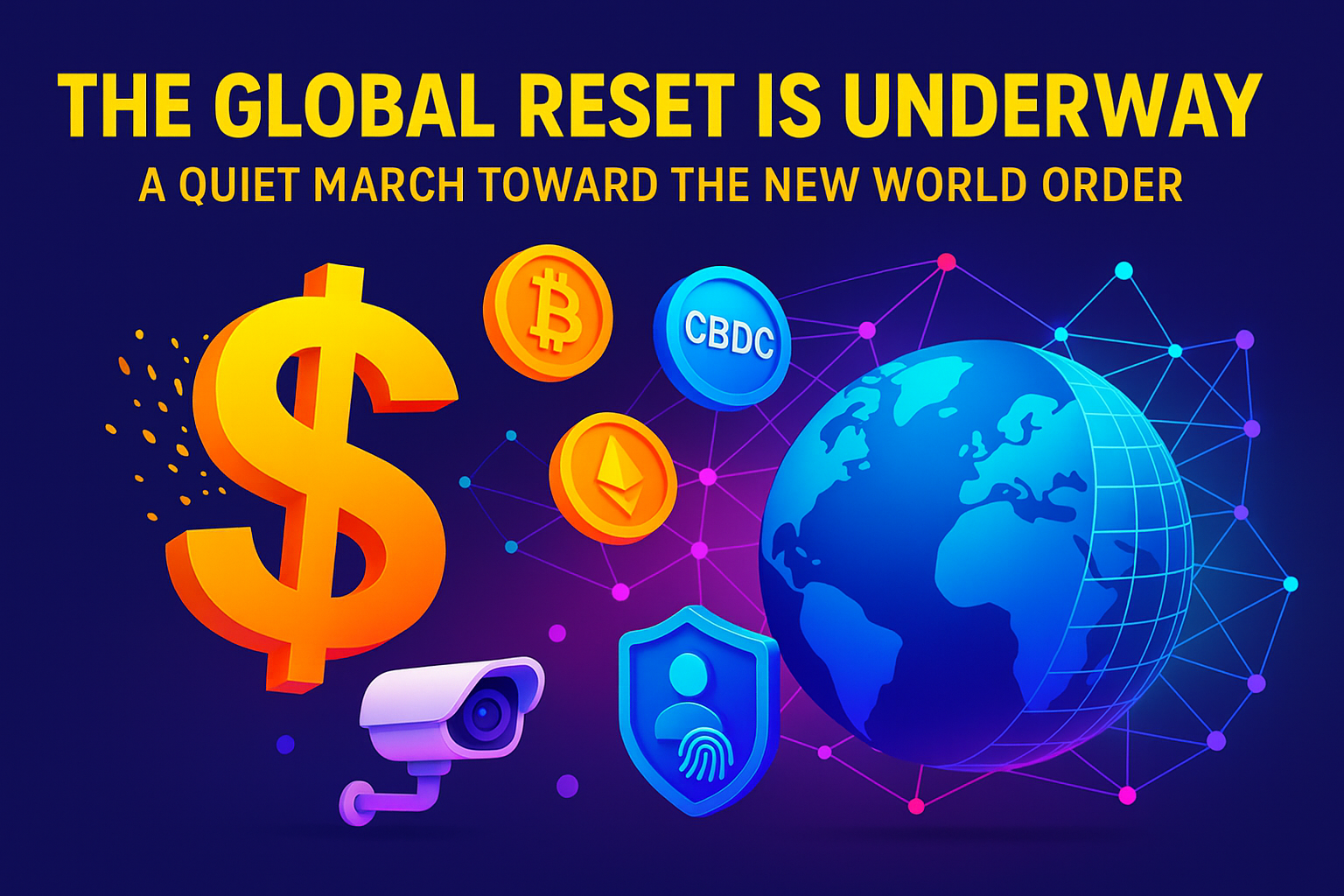
A silent global reset is transforming money, power, and control. Discover how CBDCs, digital IDs, and de-dollarisation are reshaping our future.
While much of the world remains distracted by daily headlines and political drama, a massive transformation is silently reshaping the foundations of our global civilisation. This is not a conspiracy theory—it’s visible in financial systems, geopolitical alliances, digital frameworks, and cultural narratives. A coordinated reset is unfolding right before our eyes.
1. The Dollar Is Losing Its Crown
For most of the post-World War II era, the U.S. dollar has been the bedrock of international trade. It’s been trusted, dominant, and indispensable. But that trust is fading fast. We’re witnessing a subtle but historic de-dollarisation movement across the globe.
Countries like Russia, China, Brazil, and India are bypassing the dollar in favour of local currencies and gold-backed exchanges. The BRICS nations—Brazil, Russia, India, China, and South Africa—are developing their financial network as an alternative to the Western-controlled SWIFT system. This signals a seismic pivot away from U.S. hegemony.
The rise in bilateral trade deals using the Chinese yuan, Indian rupee, and UAE dirham shows a deliberate strategy: minimise exposure to U.S. sanctions and Western financial coercion. These shifts are not sudden headlines—they’re quiet acts of financial rebellion that collectively rewrite the rules of the global economic game.
What’s being born here is not chaos, but a multipolar financial world, where no single nation dictates the terms. The dollar isn’t crashing overnight, but its monopoly is fading. And in its place? A fragmented, diversified, and more competitive currency landscape.
2. CBDCs: The Trojan Horse of Financial Surveillance
Central Bank Digital Currencies (CBDCs) are the poster child of fintech evolution. Governments promote them as efficient, secure, and modern alternatives to physical cash. But behind the glossy presentations lies a chilling reality.
CBDCs aren’t just digital money—they’re programmable money. That means central banks could decide how you spend your funds, where you can use them, and even when they expire. Imagine your paycheck vanishing in 30 days unless you spend it on “approved” products. That’s not freedom—it’s algorithmic control.
Every transaction under CBDC frameworks is trackable. Anonymity is gone. Your financial activity becomes a data point in a vast surveillance network. Step out of line? Your account could be frozen or limited without due process.
This isn’t a futuristic dystopia—it’s already happening. Countries like China have deployed digital yuan trials with geofencing and spend-limit features. Europe is preparing for a digital euro. The U.S. is quietly studying a digital dollar. Meanwhile, institutions like the World Economic Forum and the IMF are openly discussing “behaviour-based financial systems.”
What’s worse? CBDCs will likely be tied to digital IDs, social credit systems, and carbon footprint monitoring. It’s financial compliance as a lifestyle—and it’s being sold as convenience.
3. A Multipolar World Is Taking Shape
The world order dominated by the U.S. and Western allies is fracturing. Emerging powers are rejecting the old playbook and writing their chapters. This isn’t just geopolitics—it’s a civilizational shift in motion.
From Africa to Latin America, and from the Middle East to Southeast Asia, nations are realigning based on shared economic interests, cultural sovereignty, and anti-imperial sentiment. Alliances like BRICS+, the Shanghai Cooperation Organisation (SCO), and the African Continental Free Trade Area (AfCFTA) are more than acronyms—they’re vehicles of resistance against Western dominance.
Even traditionally U.S.-aligned nations are hedging their bets. France is trading in yuan. Saudi Arabia is cutting deals with China and Russia. Argentina is flirting with BRICS membership. These aren’t isolated incidents—they’re part of a strategic, coordinated drift toward a new global axis.
Gold is making a comeback as a symbol of trust. Energy resources are being weaponised as tools of negotiation. Food security is turning into a bargaining chip. These elements are becoming the new currencies of power in a world where influence is no longer dictated by the U.S. dollar or NATO’s military reach.
The age of the unipolar empire is closing. What’s coming next? A multipolar reality, where no single entity reigns supreme, but where regional blocs and cultural civilisations rise as sovereign actors on the global stage.
4. Manufactured Crises: The Sparks Behind the Reset
Take a closer look at the major global conflicts of recent years—the war in Ukraine, the crisis in Gaza, tensions over Taiwan, the pandemic, supply chain chaos, and inflation waves. Are these just random events, or do they serve a deeper purpose?
Each crisis conveniently accelerates the global transition we’re witnessing. Military conflict creates justification for financial sanctions and alternative trade mechanisms. Pandemics lead to digital IDs, health passports, and mass behavioural conditioning. Economic downturns provide political cover for sweeping reforms like CBDCs and carbon credit systems.
These aren’t just isolated “black swans.” They are engineered catalysts—strategically used to break the old world and pave the way for the new. It’s a classic technique: problem, reaction, solution. And the solutions are always conveniently prepared in advance by the same institutions pushing for global consolidation.
The growing chaos isn’t a breakdown—it’s a controlled demolition of the current order. And what rises from the rubble is already in development: a centralised system of governance cloaked in the language of climate justice, digital inclusion, and economic stability.
5. The 2025–2027 Acceleration Window
If you think these changes are far-off fantasies, think again. The timeline for full-scale rollout is already being laid out—and it’s alarmingly short.
By 2025, several nations plan to implement full CBDC frameworks. International bodies are finalising agreements on digital identity verification, universal carbon tracking, and ESG-based taxation. Expect to see phrases like “global minimum tax” and “carbon wallet” become household terms within two years.
The dollar’s dominance is projected to drop significantly as more countries adopt alternative settlement methods. International trade might be fragmented into three or four competing financial ecosystems—each with its currency, digital infrastructure, and ideological code.
Most people won’t realise what’s changed until it’s too late. Like boiling frogs, the regulations will come gradually, masked as improvements or safety measures. By 2027, the world will look familiar—but operate under a completely different rulebook.
The transformation is not coming with a bang. It’s arriving with small, incremental laws, apps, and mandates—until one day, opting out becomes impossible.
6. Digital Identity: The Backbone of the New System
As the global reset advances, digital identity is quietly emerging as its foundation. It sounds harmless—even helpful—on the surface. A secure digital ID to access services, vote, travel, or bank. But beneath the surface, it represents something far more profound: total integration into a global system that monitors, tracks, and governs behaviour.
Digital ID is already being piloted or deployed across Europe, Africa, and parts of Asia. Linked with biometric data, blockchain verification, and centralised databases, these systems can store everything from medical history to financial activity. Combine this with CBDCs, and you’ve created a feedback loop of compliance.
Want to buy groceries? Scan your digital wallet. Want access to healthcare or travel permissions? Make sure your vaccination status, carbon usage, or social behaviour checks out. Everything becomes conditional, based on the data stored in your profile.
Governments and tech giants claim this is for “efficiency” and “security.” But ask yourself: What happens when access to daily life hinges on digital approval? In the hands of a benevolent leader, such a system might work. But in the wrong hands, it becomes a tool of oppression.
Digital ID is not just a convenience—it’s the gateway to a programmable society, where algorithms can shape behaviour more efficiently than any law or military force.
7. The Rise of ESG & Carbon Credits
Environmental, Social, and Governance (ESG) scores are quietly becoming a financial litmus test for individuals and corporations alike. They’re sold as a measure of social responsibility—but in reality, they’re being used to force compliance with a global agenda under the banner of sustainability.
Think of ESG as a backdoor social credit score. Companies that don’t meet ESG metrics may lose investment opportunities, face regulatory scrutiny, or be excluded from major markets. Now imagine this being applied to individuals: your carbon footprint, social media posts, or political views could influence your financial access.
Carbon credits and personal “carbon wallets” are being piloted to limit how much meat you eat, how far you travel, and how you heat your home. It’s not just about saving the planet—it’s about shaping your behaviour through financial incentives and penalties.
This system works hand-in-hand with CBDCs and digital IDs. You’ll have a wallet with programmable money that expires, and a score based on your environmental impact. Non-compliance? Your options shrink. Comply, and you stay “green-lit.”
What we’re seeing is the monetisation of morality—where global institutions set the rules, and you either follow or pay the price. This isn’t sustainability. It’s a technocratic form of population management.
8. The Centralisation of Global Institutions
Global governance isn’t coming—it’s already here. Over the last two decades, institutions like the United Nations, World Economic Forum (WEF), World Health Organisation (WHO), International Monetary Fund (IMF), and Bank for International Settlements (BIS) have gained enormous influence over national policies.
These unelected bodies are driving the blueprint for digital currencies, pandemic response, climate control, and even migration policies. Their decisions often override local laws and democratic processes, because they act through regulatory “recommendations” that nations are pressured to adopt.
The WEF’s “Great Reset” proposal openly states the goal: reshape capitalism, digitise governance, and centralise decision-making. The WHO is pushing for a global pandemic treaty that would give it legal authority to enforce lockdowns, vaccine mandates, and travel restrictions worldwide.
This top-down system is sold as efficient and global in scope. But it sidelines national sovereignty and erodes democratic accountability. Once implemented, the framework becomes self-perpetuating. It doesn’t need tanks or armies—it uses data, influence, and regulation to rule.
We are moving into an age of centralised technocracy—governed not by elected representatives, but by interlinked bureaucracies that are insulated from the will of the people.
9. Technological Integration and AI Governance
Technology is no longer just a tool—it’s the new infrastructure of control. Artificial Intelligence (AI), machine learning, facial recognition, behavioural analytics, and predictive policing are merging into a digital panopticon.
AI can now monitor your online behaviour, flag dissent, and predict “pre-crime” based on your habits. Combined with surveillance cameras, smart cities, and biometric checkpoints, the tools of mass control are not theoretical—they’re operational.
China’s social credit system is the prototype, but it’s being studied and replicated worldwide. From Canada’s AI-powered border agents to Europe’s biometric passport systems, the groundwork is being laid.
Technocratic leaders believe data is more reliable than democracy. With AI, they can manage populations, enforce rules, and suppress dissent with surgical precision. It’s governance by algorithm—devoid of empathy, accountability, or human nuance.
As 5G and quantum computing expand, the speed and power of this digital web will only increase. The line between physical and digital life will blur—until every action you take, online or offline, is part of a tracked system.
The end goal? A society that no longer needs walls or police patrols. The system will self-regulate—with you inside it.
10. Collapse as a Pretext for Control
History teaches us that major resets don’t happen in times of peace—they emerge from collapse. Economic meltdowns, global wars, pandemics, and civil unrest create the conditions for radical transformation. Those in power know this. That’s why collapse is not feared—it’s managed.
Today’s supply chain disruptions, food shortages, and currency volatility aren’t random—they’re part of a broader transition. Every shock to the system weakens the old model and justifies the emergence of the new.
Fear makes people trade liberty for safety. Collapse enables the rollout of digital currencies, biometric IDs, centralised health mandates, and sweeping economic reforms under the guise of “emergency response.”
This isn’t new. The Patriot Act followed 9/11. Mass surveillance was normalised after global terror threats. COVID-19 gave us lockdowns, contact tracing, and vaccine passports. Each crisis tightens the noose just a little more.
We are witnessing a playbook in real-time: create a crisis, offer a prepackaged solution, and reshape society while people are too scared to resist. And once the dust settles, the system will look new, but the power will be even more centralised than before.
11. Digital Infrastructure as the New Battlefield
Wars of the past were fought over territory, oil, and ideology. But in this new era, the true battleground is digital infrastructure. Nations are racing to control the backbones of the internet, cloud storage, cybersecurity frameworks, and satellite communication systems.
Take, for example, the global fight over 5G technology. It’s not just about faster phones—it’s about who controls the data pipelines of tomorrow. Companies like Huawei and Western tech giants are proxies in a much larger geopolitical contest. Whoever builds and maintains these systems controls the flow of information, commerce, and surveillance.
Satellites are also becoming critical assets. Elon Musk’s Starlink, China’s Tiantong, and Russia’s Sphere satellite networks aren’t just for the internet—they’re for military, surveillance, and infrastructure dominance. We are watching the weaponisation of digital platforms in real-time.
Even undersea data cables, which carry 95% of global internet traffic, are being fought over. The nation that controls this infrastructure controls the internet, not just access, but the very architecture of global communication.
This digital Cold War has already begun. Cyberattacks, data leaks, and infrastructure sabotage are increasing in frequency and severity. As control centralises into fewer hands, we must ask—who owns the infrastructure that owns us?
12. Psychological Conditioning of the Masses
No global reset can succeed without the compliance of the public. And for that, mass psychological conditioning is crucial. From fear-based news cycles to social media manipulation and educational indoctrination, minds are being shaped to accept control as safety.
The pandemic was a masterclass in behaviour modification. From lockdowns to masks and vaccine mandates, governments tested how far they could push societal obedience. The results were alarming: many citizens willingly surrendered freedoms for perceived safety.
Now, similar tactics are being used to promote climate emergency narratives, digital money, and central surveillance as “solutions.” Constant fear of disease, climate catastrophe, financial collapse, or war keeps populations in a state of emotional instability. And in that state, people are more likely to comply.
Social media algorithms amplify hysteria, censor dissent, and create echo chambers. Education systems increasingly teach children to trust authority over critical thinking. Entertainment glorifies dystopia and technological control as inevitable or even desirable.
We’re not just facing a political or economic transformation—we’re facing a psychological war designed to reshape how we think, feel, and behave. And the longer we remain unaware, the more deeply the conditioning will sink in.
13. Global Taxation and Universal Basic Income (UBI)
The next phase of the reset could bring one of the most transformative ideas yet: global taxation and Universal Basic Income (UBI). Both sound noble in theory, but in practice, they may become tools of control.
Global taxation is being proposed under the banner of climate justice and income equality. The OECD and G20 have already agreed on a “minimum global corporate tax.” But what happens when this extends to individuals? Carbon taxes, digital service fees, and wealth redistribution schemes are already on the table.
UBI is being pitched as a solution to job automation and economic instability. But it comes with strings. Imagine receiving a monthly stipend from the government, programmable, conditional, and linked to your digital ID and ESG score. Miss a vaccine appointment? Speak out online? Your income could be paused.
This isn’t income—it’s allowance. A means to keep people compliant and pacified while automating their jobs and centralising control. Dependency replaces sovereignty. Compliance replaces ambition.
These programs are being tested in pilot forms around the world, from Canada to Kenya. They are being normalised not as handouts, but as the new economic model for the post-reset world. But if the money isn’t yours to control, is it freedom?
14. Resistance Movements and Parallel Societies
Not everyone is going along with the reset. Around the world, resistance is rising. From alternative media and local agriculture to decentralised finance and off-grid communities, millions are quietly building parallel societies.
These movements recognise that the only true resistance is independence from systems that seek to surveil, regulate, and program every aspect of our lives. That means growing your food, learning new skills, forming local networks, and embracing analogue alternatives to digital dependency.
Cryptocurrency communities, though under pressure, continue to thrive in the shadows of the banking system. Homeschooling networks are growing rapidly. Decentralised tech projects are creating censorship-resistant platforms and tools.
This isn’t just rebellion—it’s resilience. It’s about choosing autonomy in a world of automation, choosing connection in a world of control. The more centralised the official system becomes, the more vital it is to decentralise our lives.
This isn’t just a political act—it’s a survival strategy.
15. How to Protect Yourself in the New Paradigm
If the global reset is already underway—and all signs point to yes—then the question becomes: how can you protect yourself and your family?
Start with awareness. Understand the systems being built. Don’t take headlines at face value. Investigate, question, and learn.
Then, diversify. That means financial assets outside of centralised banking. Cryptocurrencies, precious metals, barter networks, and even land ownership can provide insulation against digital financial control.
Build local. Whether it’s relationships, food sources, or skill exchanges, your real community will matter more than your digital one. The stronger your local ties, the harder it is to isolate or manipulate you.
Go analogue. Have backups that don’t depend on the grid or the internet. Books, tools, food storage, cash, and radios are small things that become big when systems fail.
And most importantly, stay human. The future being built is one of algorithms and automation, but no machine can replace empathy, intuition, or community.
Conclusion: The Reset Is Real—What Will You Do?
The global reset is no longer theory—it’s operational. It’s reshaping the financial, political, digital, and social structures of the world in real-time. Most of it is happening silently, behind the noise of daily news cycles and partisan debates.
It’s not arriving with tanks or takeovers—it’s coming through regulation, apps, and policy shifts. And by the time most people realise it, they’ll already be embedded in a system they didn’t choose.
But awareness is power. You can still adapt, prepare, and build something outside the system. You can resist not with rebellion, but with resilience. The future will not be written by governments or corporations alone—it will be shaped by the people who decide to think critically, act locally, and protect their sovereignty.
So ask yourself: Will you conform to the new order, or create your own?
FAQs
1. What is the Global Reset?
The Global Reset refers to a coordinated shift in financial, political, and technological systems worldwide, aiming to centralise control and re-engineer societal structures.
2. Are CBDCs dangerous?
CBDCs can be useful, but when programmable, they pose serious threats to privacy, autonomy, and financial freedom, especially when tied to digital IDs and surveillance systems.
3. Is de-dollarisation a real threat to the U.S. economy?
Yes. As more countries adopt alternative currencies for trade, the dominance of the dollar weakens, which could drastically shift global economic power.
4. Can people resist the New World Order?
Absolutely. Through local action, decentralisation, alternative finance, and community resilience, individuals can maintain autonomy and reduce dependence on centralised systems.
5. Is it too late to prepare?
Not at all. While systems are already being built, awareness and proactive adaptation can help you navigate and survive the reset without becoming trapped in it.
Please don’t forget to leave a review.
#globalreset,#newworldorder,#digitalcurrency,#cbdc,#dedollarization, #brics,#digitalID,
#economiccollapse,#globalshift,#greatreset,#multipolarworld,#programmablemoney,
#carboncredits,#esg,#parallelcommunities
