

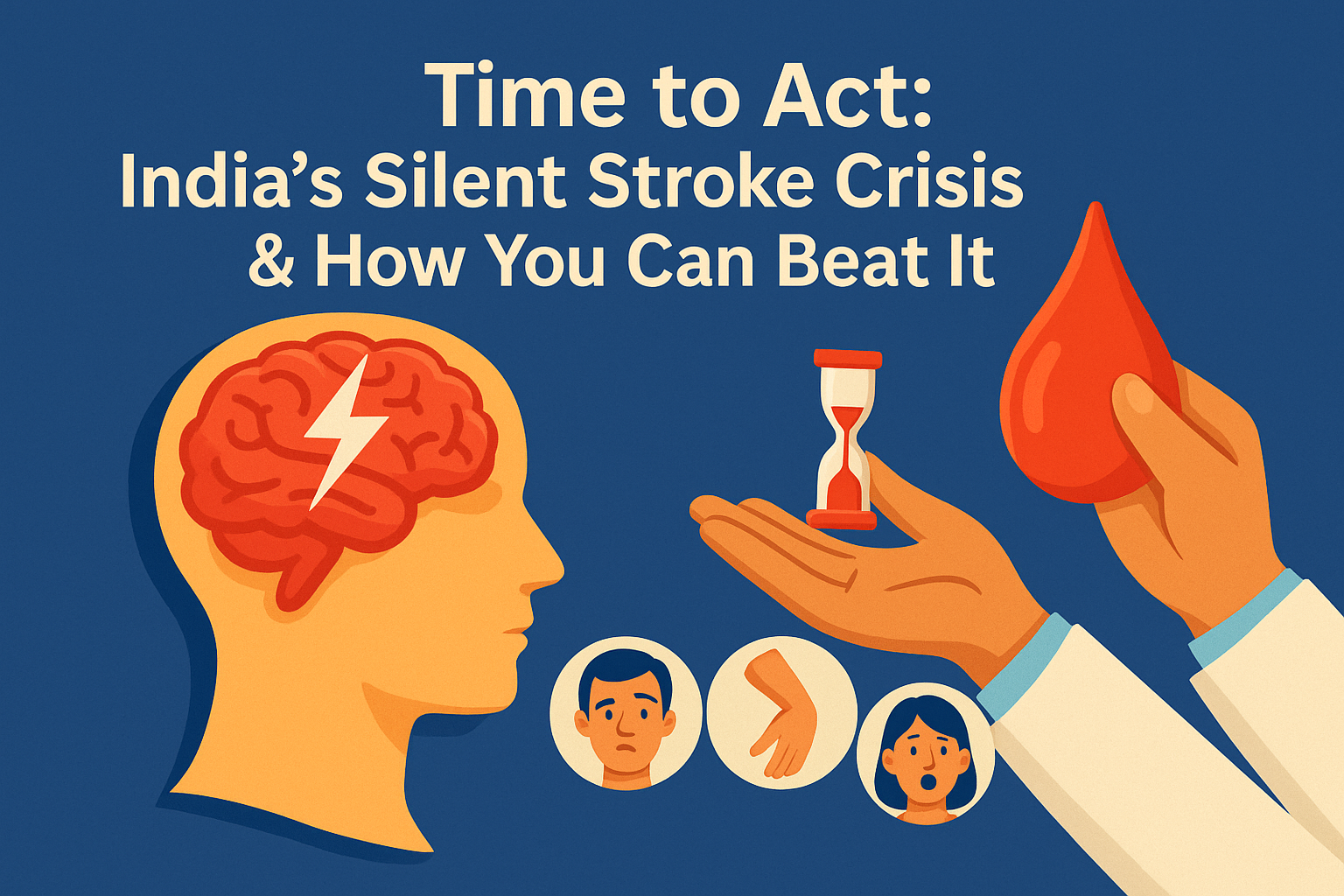
India sees a brain stroke every 20 seconds. Learn how to recognise symptoms, act fast, and save lives with expert tips and prevention strategies.
A Growing Emergency – One Stroke Every 20 Seconds
Imagine this: in the time it takes you to read this paragraph, another person in India has just suffered a brain stroke. Yes, every 20 seconds, a new case strikes, adding up to over 18 lakh new stroke cases every single year.
But here’s the real tragedy: most people don’t know what to do when it happens. They don’t recognise the symptoms. They don’t act fast enough. And because of that, lives are lost or permanently changed.
At the recent launch of the nationwide awareness campaign “Brain Stroke – Time to Act,” medical experts and public health leaders issued a stark warning: this silent epidemic is worsening, and we need urgent action—not tomorrow, but right now.
What is a Brain Stroke?
Let’s keep it simple. A brain stroke happens when blood can’t reach part of the brain. Without oxygen, brain cells begin to die within minutes.
There are two main types:
- Ischemic Stroke (about 85% of cases): A blood clot blocks an artery in the brain.
- Hemorrhagic Stroke: A weakened blood vessel bursts and bleeds into the brain.
No matter the type, the results can be devastating—loss of speech, paralysis, memory loss, and in many cases, death.
But here’s the silver lining: many strokes can be treated or even prevented if you know what to look for—and act fast.
Why Ischemic Strokes Dominate in India
According to Dr. P. Vijaya, President of the Indian Stroke Association, ischemic strokes are by far the most common in India. Why?
Blame it on a mix of things:
- Sedentary lifestyles
- High rates of diabetes, high blood pressure, and cholesterol
- Smoking and pollution
- Low awareness of preventive care
But here’s what’s worse: even though millions are eligible for life-saving treatment, only 1% receive it in time. That’s not just a statistic—that’s a heartbreak waiting to happen.
The Golden Window – Why Time Equals Brain
You might’ve heard the phrase “time is money,” right? When it comes to a stroke, it’s more accurate to say: time is of the essence.
The golden window is the critical first 4.5 hours after stroke symptoms appear. Within this time, a medication called IV thrombolysis (a clot-busting injection) can drastically improve outcomes. It melts the clot blocking blood to the brain.
But here’s the problem: most patients don’t reach the hospital in time. Why? Because they:
- Don’t know the signs
- Don’t take symptoms seriously
- Waste precious minutes waiting for symptoms to pass
Acting quickly could be the difference between walking out of a hospital… or never walking again.
The Warning Signs You Must Never Ignore
When a stroke hits, your brain sends you signals. You just need to know how to read them.
Use the FAST method:
- F – Face drooping: Is one side of the face numb or drooping?
- A – Arm weakness: Can’t lift both arms evenly?
- S – Speech difficulty: Slurred or strange speech?
- T – Time to call: If you notice any of these, call emergency services immediately.
And don’t forget these lesser-known symptoms:
- Sudden loss of vision (in one or both eyes)
- Sudden confusion or trouble understanding
- Loss of balance or coordination
- A sudden, severe headache (with no known cause)
Even if symptoms disappear quickly, it could be a mini-stroke (TIA)—a major warning sign for a future, more severe attack.
How Age, Gender & Background Don’t Shield You from Stroke
One of the most dangerous myths around stroke is that it “only happens to old people.” That’s simply not true anymore.
Today, more young Indians—some even in their 20s and 30s—are experiencing strokes. And it’s not limited to any one group. Rich or poor, male or female, educated or not—it doesn’t matter. Stroke is an equal-opportunity killer.
As Dr. P. Vijaya emphasised, “Stroke can happen to anyone. The only thing that truly helps is awareness and a fast response.”
This is especially relevant in urban India, where stress, junk food, sedentary jobs, and smoking are taking a silent toll on younger generations. Meanwhile, rural India suffers from a lack of access to timely care, which makes education about stroke even more vital.
India’s Healthcare Challenge: Why So Few Get Timely Treatment
Only 1% of stroke patients in India get the necessary clot-busting injection in time. That number is shockingly low compared to global standards.
Why? Here’s the reality:
- Lack of public awareness
Most people can’t recognise the early signs of stroke or don’t understand how urgent the situation is. - Late hospital arrivals
Precious minutes are wasted before seeking help. By the time patients reach stroke-ready hospitals, it’s often too late. - Shortage of trained specialists and stroke-ready centres
Only a limited number of hospitals are equipped to give IV thrombolysis or mechanical thrombectomy, the advanced clot-removal procedure. - Cost and accessibility barriers
Even when treatment is available, high costs and long travel distances can prevent timely intervention.
The result? Thousands of Indians suffer avoidable brain damage or death every year.
How You Can Protect Yourself (and Your Family) from Stroke
Here’s the good news: up to 80% of strokes are preventable. You just need to take charge of your health. Here’s how:
✅ Know Your Risk Factors:
- High blood pressure (No.1 cause!)
- Diabetes
- Smoking and alcohol
- High cholesterol
- Obesity
- Atrial fibrillation (an irregular heartbeat)
✅ Adopt a Brain-Healthy Lifestyle:
- Eat better – Focus on fruits, vegetables, whole grains, and less salt.
- Move more – Just 30 minutes of walking a day can reduce your risk.
- Sleep well – 7–8 hours of quality sleep is crucial.
- Manage stress – Try yoga, meditation, or just switching off for a while.
- Get regular checkups – Don’t wait for symptoms to act.
✅ Educate your family:
If a stroke happens at home, will your family know what to do? Make sure they do. It could save your life—or theirs.
Why Public Awareness Campaigns Like ‘Time to Act’ Matter
The “Brain Stroke – Time to Act” campaign launched by the Indian Stroke Association is a critical step in changing the narrative. Its goals are simple but powerful:
- Educate people about stroke symptoms and prevention
- Promote FAST response in emergencies
- Encourage hospital readiness and specialist training
More campaigns like this are urgently needed—not just in major cities, but in every village, school, and workplace across India.
Hope on the Horizon: What the Future Looks Like
There’s no doubt the situation is dire, but not hopeless.
With growing awareness, new technologies, and better hospital protocols, the tide can turn.
Innovations like:
- Telemedicine for stroke diagnosis
- AI-based stroke detection apps
- Ambulances equipped for emergency scans
are being explored and implemented in parts of India. But they need to go mainstream—and fast.
Government support, private sector investment, and public cooperation must come together. Because every second saved truly is a brain cell saved.
Conclusion: Be the Difference Between Life and Death
Stroke may be fast, but so can you be.
Learn the signs. Spread the word. Take control of your health. And never, ever ignore the warning signals. Because when stroke strikes, you don’t get a second chance.
Act fast. Save lives. Be the reason someone lives to tell their story.
5 Unique FAQs on Stroke in India
1. Can young people get a stroke?
Yes. Lifestyle habits and rising stress levels mean even those in their 20s and 30s are at risk.
2. What is the most important thing to do if I suspect a stroke?
Call emergency services immediately and rush the person to a hospital that is stroke-ready.
3. Can a stroke be completely prevented?
While not 100% preventable, adopting a healthy lifestyle and managing risk factors significantly lowers your chances.
4. What happens if a stroke is not treated within the golden window?
Delays can cause permanent brain damage, disability, or death. Treatment within 4.5 hours is vital.
5. Are there apps that help detect stroke?
Yes, AI-driven apps and telemedicine tools are emerging to assist early diagnosis, especially in remote areas.
Please don’t forget to leave a review.
