
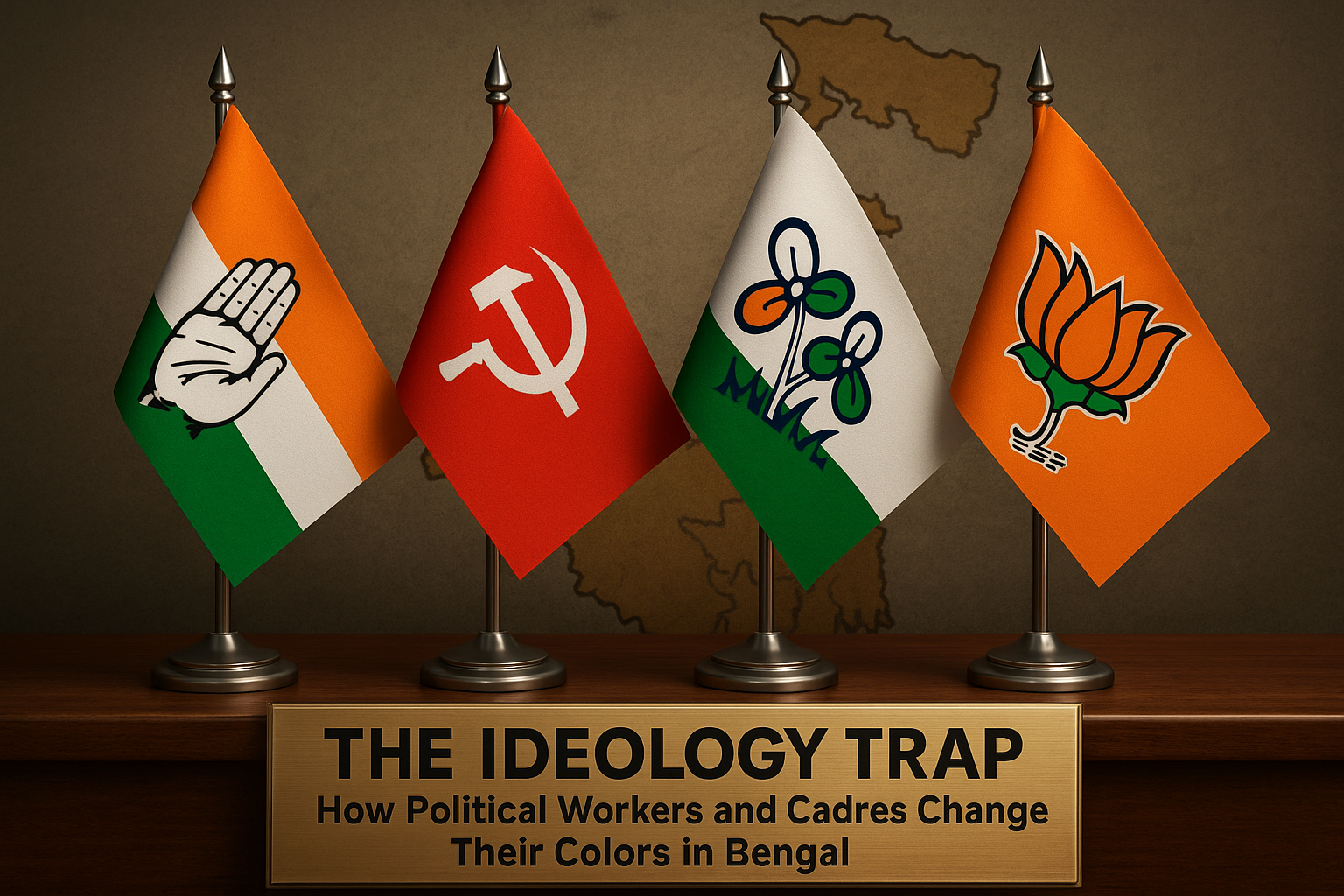
The ideology trap of Bengal politics: how cadres shift from Congress to CPI(M), then to TMC, and now BJP, exposing the reality of power over principles.
West Bengal has long been a fascinating theatre of politics. For decades, the Left Front ruled with its rigid ideology of class struggle. Before that, the Congress commanded loyalty through the legacy of Independence and Nehruvian socialism. In the 2000s, Mamata Banerjee’s Trinamool Congress (TMC) swept the state with the promise of Ma, Mati, Manush. And today, the BJP is a rising force, riding on a wave of Hindutva and central power.
But beneath this dramatic shifting of parties lies a quieter, more uncomfortable reality: cadres and workers change sides as easily as a commuter switches trains.
From Congress to CPIM: The First Exodus
In the late 1960s and 70s, as the Left emerged, thousands of Congress foot soldiers switched allegiances. Land reforms and the promise of “people’s power” gave the CPI(M) a moral high ground, and grassroots workers aligned accordingly.
From CPIM to TMC: Winds of Change
By the late 1990s, the CPI(M)’s iron grip had begun to rust. Corruption, arrogance, and bureaucratic stagnation alienated the masses. When Mamata Banerjee broke away and launched TMC, she didn’t just build a party—she absorbed the CPI(M)’s machinery. Entire villages of workers changed from red flags to green overnight.
From TMC to BJP: The New Realignment
In the last decade, the BJP’s rise in Bengal has been dramatic. Again, cadres shifted loyalties, this time from TMC to BJP. The same workers who once swore by Marxism, and later by Ma-Mati-Manush, today chant “Jai Shri Ram.”
The Core Question: Where Is Ideology?
If a cadre can be Congress today, CPI(M) tomorrow, TMC the next day, and BJP after that—what does this say about ideology? For many workers, ideology is a banner, not a belief. The real motivators are:
- Access to power and resources
- Survival in local politics
- Jobs, contracts, influence
In Bengal, politics is less about “isms” and more about pragmatism.
The Trap of Loyalty Without Belief
This fluidity creates what we can call the ideology trap: parties keep selling ideals, but cadres treat them as currency to be traded when the winds shift. As a result, the public sees little difference between slogans, only between who controls the state machinery at a given time.
The Reality Check
West Bengal politics is not about ideological purity. It is about power, networks, and adaptability. The worker who once painted walls for Congress is now waving saffron flags. The village strongman who collected levies for the CPI(M) now campaigns for TMC or BJP.
In this churn, ordinary citizens are left wondering:
If the custodians of ideology treat it as negotiable, why should the public treat it as sacred?
