
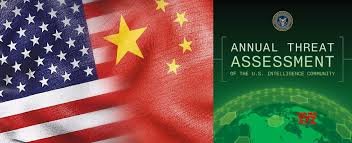
Washington D.C. | March 26, 2025:
In a comprehensive annual threat assessment report, the U.S. Intelligence Community has identified China as the most significant military threat to American national security interests, surpassing all other global adversaries in terms of long-term strategic risk.
The findings, made public during a high-level Congressional briefing, highlight Beijing’s accelerated military modernization, its assertive stance in the Indo-Pacific region, and its growing nuclear and cyber warfare capabilities as key factors contributing to the threat perception.
⚠️ Key Highlights from the Report:
- China is rapidly expanding its military footprint — both regionally and globally — with the goal of becoming a dominant global power by the mid-21st century.
- The People’s Liberation Army (PLA) is increasingly capable of projecting force beyond its borders, particularly in disputed zones like the South China Sea and near Taiwan.
- Beijing’s investment in artificial intelligence (AI), cyber warfare tools, hypersonic weapons, and space-based military assets poses direct challenges to U.S. technological superiority.
- China’s political and economic influence operations, particularly in developing nations and multilateral organizations, are seen as strategic efforts to reshape the international order to its advantage.
🛡️ U.S. Response and Strategic Shift
In response to these growing concerns, the U.S. Department of Defense has increased its defense budget allocations toward Indo-Pacific security, strengthened military alliances with Japan, Australia, and India, and intensified efforts under the Quad and AUKUS partnerships.
U.S. intelligence officials emphasized that while Russia remains an active short-term threat, especially due to its actions in Ukraine and Eastern Europe, China poses a more comprehensive, long-term challenge that could reshape the global balance of power.
🧭 Geopolitical Implications
The report comes at a time of rising U.S.-China tensions over a wide range of issues including:
- Taiwan’s sovereignty
- Trade and technology wars
- Human rights concerns in Xinjiang and Hong Kong
- Cyber espionage incidents targeting U.S. infrastructure
Strategic analysts have warned that miscalculation or lack of dialogue between the two nuclear powers could lead to heightened instability or even conflict in the coming years.
