
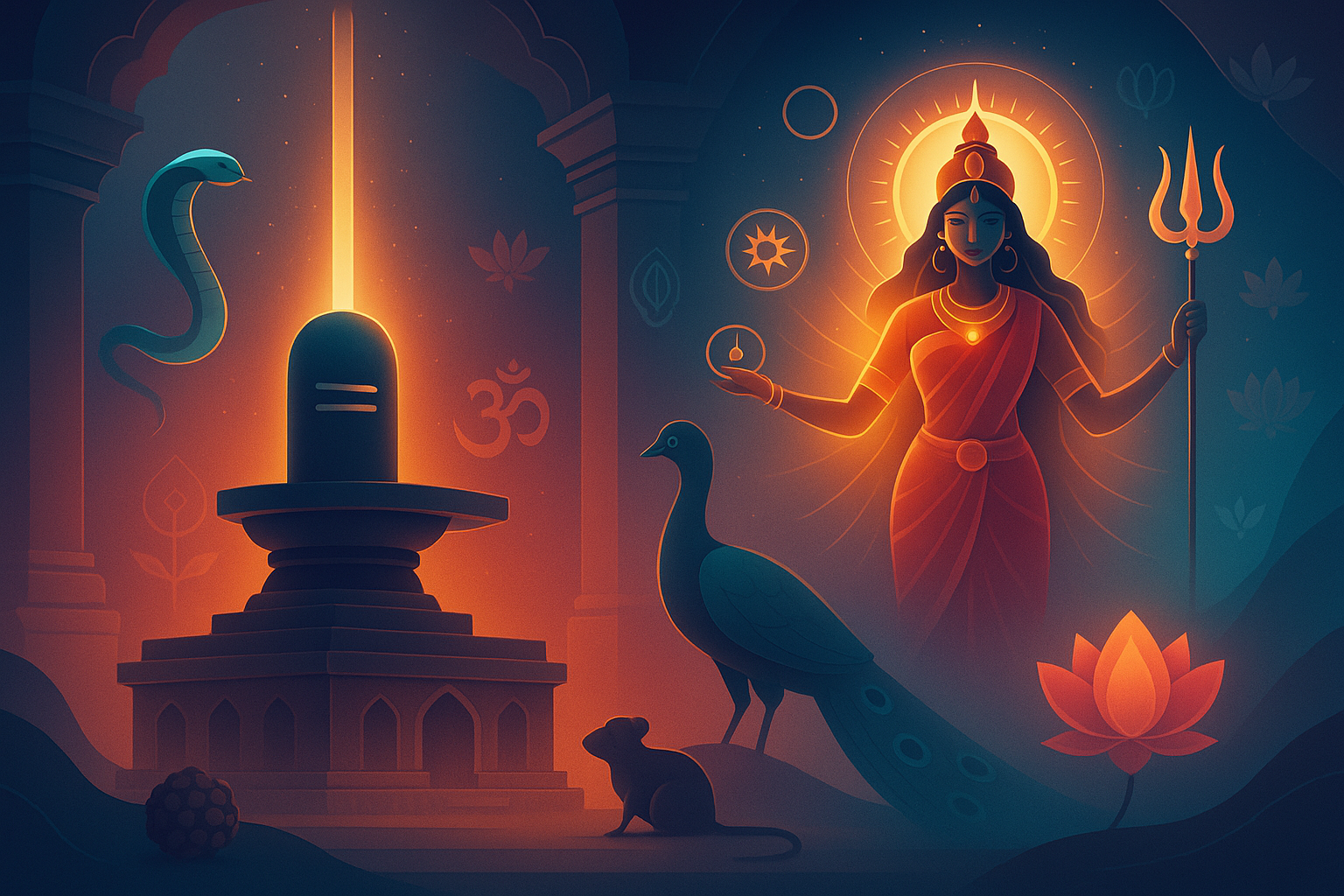
Explore India’s mystical legacy—from growing idols and talking dreams to goddesses-led power shifts—in a journey where myth, miracle, and meaning collide.
India’s Hidden Mystics: Where Legends Breathe, Idols Grow, and Goddesses Reign
India isn’t just a country—it’s a living epic, a sacred contradiction where gods walk among mortals, temples pulse with invisible presence, and faith becomes fact. Here, history blends with myth, and reality often blurs into wonder. Across dusty village paths and ancient stone shrines, you’ll find stories that modernity can’t explain—and science often dares not touch.
This is a land where deities aren’t confined to rituals—they sleep on beds, whisper in dreams, and reveal themselves in growing stones and living symbols. It’s a mystic terrain where belief isn’t merely tradition—it’s testimony. These aren’t just spiritual tales—they’re lived truths, preserved by generations, embedded in the soil, and guarded by silence.
Let’s begin where it always begins in India: in the divine, in the strange, in the ordinary that turns extraordinary the moment you stop doubting.
The Forgotten Temples and Supernatural Legends of India
India’s temples aren’t just places of worship—they’re repositories of ancient energies. Step into the deeper interiors, far from city lights and tourist circuits, and you enter a realm where the rules of reality seem negotiable.
In the dense heart of Bastar, for instance, lies a small, lesser-known temple dedicated to Lord Krishna. It’s not the grandeur of the structure that catches your breath, but what happens when the sun sets. At exactly 7 or 8 in the evening, villagers close their ancient wooden doors—no bells, no announcements. And then… silence. The temple is left untouched till dawn. Come morning, when the doors creak open, the arrangement inside is never as it was.
The plain bedding, once laid carefully for the deity, is found tossed around, disturbed, as if someone had rested there overnight. Villagers believe Lord Krishna himself returns every night to rest. This isn’t treated as a myth—it’s acknowledged as a truth.
And the story doesn’t end in belief—it spills into the physical world. A foreign visitor, fascinated by the tale, once tried to spy through the temple door late at night. What he saw is unknown because he could never speak of it. Locals say he lost both his speech and sight in that moment. Today, he still sits there, silent, blind, a symbol of curiosity punished. The villagers don’t mock him. They revere his silence as sacred.
Across Maharashtra, another village defies logic. Shaitpal—a name unknown to most—is home to hundreds of families who share their living space with cobras. Yes, real snakes. Every home has a designated niche in its walls where a cobra resides. There are no cages, no glass tanks—just cohabitation. Children grow up unfazed, cobras slither silently through kitchens and courtyards, and no one is harmed. Not out of fear, but reverence. These snakes are seen as spiritual guardians, not threats.
You can’t manufacture this kind of belief. You can’t explain it away. And perhaps, that’s the point. In these forgotten places, India doesn’t seek to be understood—it simply is.
Living Mystics: When Idols Grow and Dreams Speak Truth
What if a tree could tell you where to dig? What if dreams weren’t just symbols, but directions?
In a quiet corner of Ambikapur, Chhattisgarh, a farmer once had a recurring dream. In it, Lord Hanuman appeared, pleading for rescue. “I’m trapped,” he said. Every night, the same dream. Every night, the same path is shown. And so, one morning, the farmer picked up an axe and followed the route he saw in his sleep.
People laughed. They called him mad. “What Hanuman? What dream?” they said, as he walked to a large tree and began cutting at the exact spot shown to him. What he uncovered wasn’t roots. It was an idol. Buried. Intact. And growing.
The idol started small—about two feet. But each year, it grows. Not symbolically. Physically. Today, it stands nearly nine feet tall. A temple now covers the space. But the miracle remains uncovered. You can see the older pictures. Compare them. The difference is undeniable. It isn’t legend—it’s living proof.
Then there’s the Shivling of Khajuraho, often overshadowed by its more sensational Kamasutra carvings. Few know that hidden within this complex stands a Shivling that defies age and time. It’s growing—inch by inch, every few years. Locals have photographs, spanning decades, showing a marked rise in height. It now stands over seven feet tall. And the roof of the temple, built years ago, may soon be touched by it.
Who measures this? Who confirms it? No one. And yet everyone knows.
These stories aren’t about blind faith—they’re about sight deeper than vision. A knowing that rises not from the mind, but from the marrow of generations.
The Divine Table: Harmony Between Gods, Animals, and Energy
In Hindu lore, symbolism isn’t poetic fluff—it’s embedded philosophy. And nowhere is this more evident than in the vehicles (vahanas) of deities.
Think of it: Shiva sits with a snake curled calmly around his neck. His elder son, Kartikeya, rides a peacock, known to eat snakes. His younger son, Ganesha, rides a mouse, prey to both. And yet, the divine family shares a space. A cosmic dinner table, if you will, where the snake doesn’t strike, the peacock doesn’t chase, and the mouse nibbles in peace.
It’s more than a metaphor—it’s a model of harmony. The apex predator and the smallest rodent share space under one roof. Why? Because when divinity is present, ego dissolves. Instinct yields to stillness. Power coexists with vulnerability.
And yet, this table is incomplete without the lion—the vahana of Parvati. She is not just the fourth member of the family—she is the axis around which it turns. Her vehicle isn’t passive or humble. It’s the king of the jungle. And when she takes her seat, everything else finds its place.
In Indian tradition, this is why we invoke the feminine before the masculine. Lakshmi-Narayan. Sita-Ram. Radha-Krishna. Not alphabet, not rhythm—reverence. The feminine completes the divine. Without her, the cosmic family is only a silhouette.
The Power Shift We Forgot: Why the Goddess Was Always First
Centuries of social conditioning have made it easy to forget: before every god, there was a goddess. Not just in ritual, but in creation. In every Purana, the sequence of divine appearance varies—Vishnu brings Shiva and Brahma in one, and Shiva creates them in another. But all narratives, even in their contradiction, circle one truth: the feminine power predates and sustains all.
In modern language, we’ve replaced the Queen of the Universe with the watchman of the gate. We’ve confused the guardian for the ruler, the protector for the creator. And in doing so, we’ve exiled the goddess from her throne. She who decides who enters the city of creation is now relegated to the margins of worship, praised only in festivals, rarely understood in philosophy.
Yet, her presence is unmistakable. Every temple that glows with divine energy pulses with Shakti. Every god’s power is incomplete without her presence. Shiva without Parvati is Shava—just a corpse. Vishnu rests on Lakshmi. Even the playful Krishna becomes divine through Radha’s devotion.
This is why Indian traditions place her name first, not out of courtesy, but recognition. Because before creation comes consent. And that consent lies with the feminine. She is the gate. She is the source.
From Radha-Krishna to Siyaram: The Feminine Divine Comes First
Look closely at the names of India’s divine pairs. Radha-Krishna. Sita-Ram. Lakshmi-Narayan. Gauri-Shankar. The pattern is deliberate—and it’s not just poetic.
In every pairing, the goddess precedes the god. Linguistically, the softer syllables roll first. Spiritually, the energy flows from Shakti to Shiva, not the other way around. It’s a cultural code—a reminder inscribed in speech itself.
This order isn’t merely symbolic—it’s structural. In ancient societies, where male deities dominate global religious canons, Hinduism preserves a unique duality. The goddess is not merely a consort; she is creator, protector, and destroyer. She births the trinity and breaks the tyrants. She is at once the field and the seed, the sword and the lullaby.
Yet, the shift is silent. She isn’t proclaimed from the rooftops. Her strength lies in stillness. But when required, she erupts as Durga, Kali, Bhairavi—not in rage, but in response. Not to conquer, but to restore balance.
This is why the feminine divine remains first. Not because we remembered, but because she never let us forget.
Durga, the Cosmic Conqueror: When One Woman Held the Power of Three Gods
There once lived a demon no god could defeat—Mahishasura. Armed with power, arrogance, and invincibility, he stormed through realms, unchecked. Brahma, Vishnu, and Shiva, the holy trinity, stood helpless. Not because they lacked power, but because they lacked what only the goddess possessed: integration.
And so emerged Durga—not born, but formed. She did not arrive fully made. Each god offered her a piece of their strength. Shiva gave her the trident. Vishnu offered the chakra. Brahma handed her the kamandalu—the vessel believed to contain cosmic energy itself.
No male body could contain all of it. Only she could.
Think of it as myth meeting metaphor: three forces, each representing a domain—creation, preservation, destruction—found their culmination in one being. Durga wasn’t just a warrior goddess—she was synthesis. She wasn’t an answer to Mahishasura. She was the solution to the imbalance.
Her story reminds us that sometimes, power isn’t what you wield alone, but what you carry for others. And that ultimate strength is not masculine or feminine—it’s complete.
Science Meets Shakti: From Purana to Particle
What if myth wasn’t the opposite of science, but its forerunner?
Let’s look at what Durga held: a trident, a discus, a water vessel. Now, bring in atomic science. At the core of every atom are three elements: the proton, the neutron, and the electron. Separate, they exist. Together, they create matter. No single force can birth existence, but when they unite, energy manifests.
Similarly, the tools Durga wields are more than weapons. They are symbols of cosmic forces: the trident splits energy into three strands, the chakra represents cyclical time and eternal motion, and the kamandalu contains the universe’s primal substance—Brahmadravya.
And who contains it? Not a god. A goddess.
Modern physics now explores concepts ancient seers encoded in symbolism. Quantum duality, wave-particle theory, and cosmic singularity—all find echoes in Vedic literature. Myth, then, isn’t primitive fiction—it’s poetic compression. And nowhere is this more powerful than in the story of Shakti.
Science, at its best, observes. Myth, at its best, remembers. Together, they awaken.
Electrons, Protons & Goddesses: The Sacred Physics of Power
Try to imagine this: a being so vast, she contains the forces of every creator, sustainer, and destroyer. Not one of them. All of them. That’s what Durga represents.
In the atomic world, this would be fusion—combining elements to release tremendous power. But even fusion requires a core, a stabiliser. In myth, that stabiliser is the goddess.
When the trinity couldn’t defeat Mahishasura, they didn’t send an army. They unified their essence into a feminine form. This isn’t a tale of divine gender. It’s a tale of divine capacity. Of completeness.
Even pop culture nods to this. Think of science fiction’s “Fantastic Four,” merging into one body to fight a cosmic threat. That’s Durga—in Vedic terms. She doesn’t represent women over men. She represents the whole over the fragmented. She is not balanced—she is beyond balance.
She is what happens when the universe realises that no single power—logic, emotion, force—can preserve order. Only integration can. Only her.
Trident, Chakra & Kamandalu: The Divine Toolkit Explained
In the chaos of war and the silence of meditation, Indian deities are always depicted with tools, not just symbols, but metaphysical instruments. Among the most powerful are the trident (trishul), the chakra, and the kamandalu. But why these? And what do they mean?
The trident, wielded by Shiva and given to Durga, isn’t merely a weapon—it’s a representation of triadic energy. Creation, sustenance, destruction. Past, present, future. Mind, body, soul. The trident pierces illusions and aligns power across dimensions.
The chakra, often seen in Vishnu’s hand, isn’t just a rotating disc of light. It embodies time itself. It’s the cycle of karma, the eternal return, the wheel of life that moves ceaselessly. When handed to Durga, it becomes the power to dismantle repetitive evil, not just defeat, but unmake.
Then there’s the kamandalu, the humble water pot carried by Brahma, often overlooked. But it holds brahmadravya—the essence of existence. When Durga accepts it, she becomes the custodian of creation’s core. She doesn’t just protect the world—she carries its secret inside her.
These tools aren’t decorative—they’re codes. The keys to understanding the universe are not through domination, but awareness. In her hands, they become something more than divine—they become eternal.
Faith Beyond Sight: When Belief Turns Tangible
We often say, “I’ll believe it when I see it.” But in India, many believe because they’ve seen, and what they’ve seen defies explanation.
What do you do with a Shivling that rises every few years? A Hanuman idol that grows in size, witnessed by thousands? A temple bed that’s tossed each morning as if a god rested on it? A blind man who dared to look, and a mute who tried to tell?
Faith here isn’t abstract. It’s visceral. It can be photographed, touched, even feared. But perhaps the most profound part of it is not that it proves anything, but that it invites you in. Not as a sceptic, not as a believer—but as a witness.
India doesn’t ask you to choose between science and spirituality. It offers a third path: presence. Come. See. Feel. And decide for yourself.
Why These Stories Matter More Than Ever Today
In an age of algorithms and artificial intelligence, tales of gods sleeping, snakes cohabiting, and dreams birthing temples may sound outdated. But that’s precisely why they matter.
These stories are not mere nostalgia—they’re anchors. Reminders that not everything needs to be explained, dissected, or monetised. Some truths are lived, not proven. Some realities are sensed, not measured.
As modern India sprints toward global power status, its soul still resides in these quiet corners—in Bastar’s silent temples, in Ambikapur’s tree-idol, in the mother goddess rising through stone and song. If we lose touch with this mystical undercurrent, we risk becoming powerful—but hollow.
These stories aren’t escapism. They’re resistance. Against forgetting. Against flattening. Against living in a world without wonder.
Conclusion: The Real Miracle Is That We Still Believe
In a world saturated with facts, figures, and fast takes, India whispers something timeless: There’s more. More than the eye can see. More than the mind can grasp. A growing idol, a recurring dream, a goddess who absorbs the universe—these are not just cultural artefacts. They are blueprints of a worldview where the seen and unseen dance in unison.
The miracle isn’t that Hanuman came out of a tree or that the Shivling is rising. The miracle is that millions still stop, bow, and believe—not blindly, but with a knowing that logic may never decode.
That is India’s hidden mystical legacy. Not just the stories, but the soul that sustains them.
FAQs
1. Are there temples in India where idols grow over time?
Yes. Multiple sites, including Khajuraho and Ambikapur, report growing idols like Shivlings and Hanuman statues. These claims are supported by photographic evidence over the years.
2. What is the significance of a goddess holding weapons from other gods?
It symbolises the unity of all divine energies in the feminine form—Durga. It reflects her capacity to integrate and wield power from all domains.
3. Why do Indian names often place the goddess before the god?
This reflects spiritual hierarchy and respect. In Indian tradition, the feminine is seen as the origin of creation, hence always mentioned first—e.g., Sita-Ram, Radha-Krishna.
4. Is there a village where cobras live in every house?
Yes. The village of Shaitpal in Maharashtra is known for its unique tradition of coexisting peacefully with cobras in homes.
5. Are these stories scientifically proven?
Not always in a conventional sense, but they are widely witnessed, documented, and lived as truths by local communities. Their value lies in lived experience, not laboratory validation.
Please don’t forget to leave a review.
