
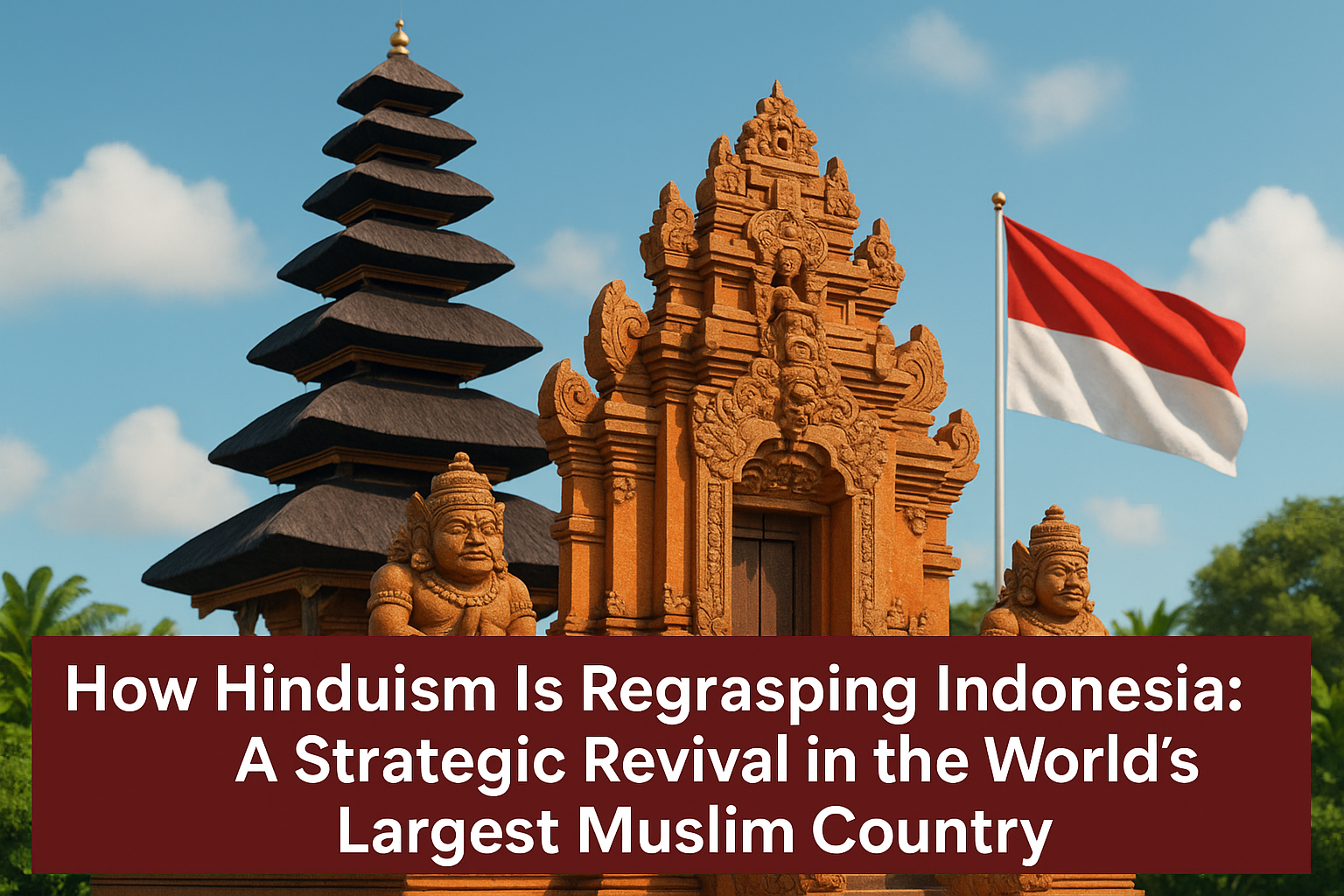
Indonesia’s Hindu revival—temple rebuilds, Sanskrit names, DNA claims—signals a conscious return to pre-Islamic roots, redefining its democratic identity.
A paradox unfolds: in the world’s largest Islamic nation, Indonesia, Hinduism—the faith of ancient empires—is staging a quiet yet forceful resurgence. No guns. No mass conversions. Just rebuilding temples, reclaiming Sanskrit heritage, and reawakening civilizational consciousness.
Layered History: Civilizational Ties and Ideological Shifts
Indonesia’s Hindu roots stretch back centuries—Srivijaya, Majapahit, and ancient Java were Indianized realms, infused with Sanskrit, Ramayana, and Mahabharata. Sanskrit-derived names like Indra, Krishna, and Sri remain ubiquitous among Javanese and Balinese. Today,t hese are not relics—they are living signifiers.
Islam arrived softly, from Gujarat, Arabia, and Persia, through merchants and Sufi saints. It interwove with local traditions, but never entirely displaced them. The result? A customised Indonesian Islam. Yet over the last decades, authoritarian populism and geopolitical realignments nudged the pendulum away from pluralism.
The Main Argument: Revival as Moral and Geopolitical Strategy
Indonesia’s re-embrace of its Hindu heritage—restoring temples, reviving Sanskrit, and open DNA claims—reveals strategic clarity. It’s neither reactionary nor colonial. It is a muscle-flexing of soft power.
President Prabowo Subianto, India’s Republic Day guest, proudly declared he has “Indian DNA,” and underscored that many Indonesian names derive from Sanskrit. The Economic Times. This isn’t mere pageantry—it’s geopolitical choreography. It broadcasts a democratic, multipolar identity anchored in normative justice and historical rootedness.
Contrasts and Ironies: Democracy vs. Authoritarian Populism
Contrast Indonesia’s increasingly visible Hindu revival with its internal religious struggles—Muslim-Christian tensions, minority repression, and digital Islamism. Here lies a sharp irony. On one hand, Hindu temples like Jakarta’s Shri Sanathana Dharma Aalayam and the colossal Murugan Temple in West Jakarta are inaugurated with state support. On the other hand, Islamist populism often challenges pluralism.
Indeed, initiatives like “1000 Chandi Nusantara” aim to restore and build temples across Bali and Java 4Hindu Vishwa. This revival is framed as cultural preservation, but at its heart lies a political creed: a multi-faith democracy asserting moral sovereignty against religious homogenization.
Geopolitical Choreography: Local Revival, Global Presence
Indonesia isn’t alone in reclaiming its civilizational DNA. ASEAN nations, alarmed by regional tensions, are rediscovering roots—Vietnam with Confucianism, Thailand with Theravada revival. For Jakarta, Hinduism’s return bridges India and ASEAN, reinforcing its Act East diplomacy and democratic alignment in the Indo‑Pacific.
Sanskrit phrases—Kartika Eka Paksi, Adhitakarya Mahatvavirya—adorn the military’s mottos, echoing ancient dharmic principles Wikipedia. The narrative is clear: Indonesia is reclaiming soft power through its symbolic heritage.
Ironies of Soft Conversion vs. Hard Security
This revival is non‑coercive—Temples revived, priests installed, festivals revived. No forced conversions. No destruction of mosques. Just cultural fertilisation. Yet the moral clarity is potent. Indonesia shows that identity revival need not be authoritarian. It can be democratic, pluralistic, and creative. The irony? In its embrace of Hindu continuity, Jakarta strengthens its global legitimacy—others lose respect when they abandon their roots for ideological populism.
Closing: A Warning and a Model
Like bamboo in a storm, Indonesia bends between global pressures—but it doesn’t break. It harnesses cultural resurgence not as retreat, but as renewal. In its embrace of Sanskrit, ancient epics, DNA heritage, and temple restoration, Jakarta offers a model: democratic sovereignty through civilizational memory.
Yet the warning is firm: strategic ambiguity without moral clarity can be dangerous. Democracy demands public conviction. Pluralism demands cultural courage. Indonesia’s Hindu revival is not just a cultural renaissance—it’s a strategic stance in the global theatre of normative order. If Jakarta can wield this soft power responsibly, it may symbolise the next frontier of multipolar democracy.
Silence, here, would indeed be surrender.
