
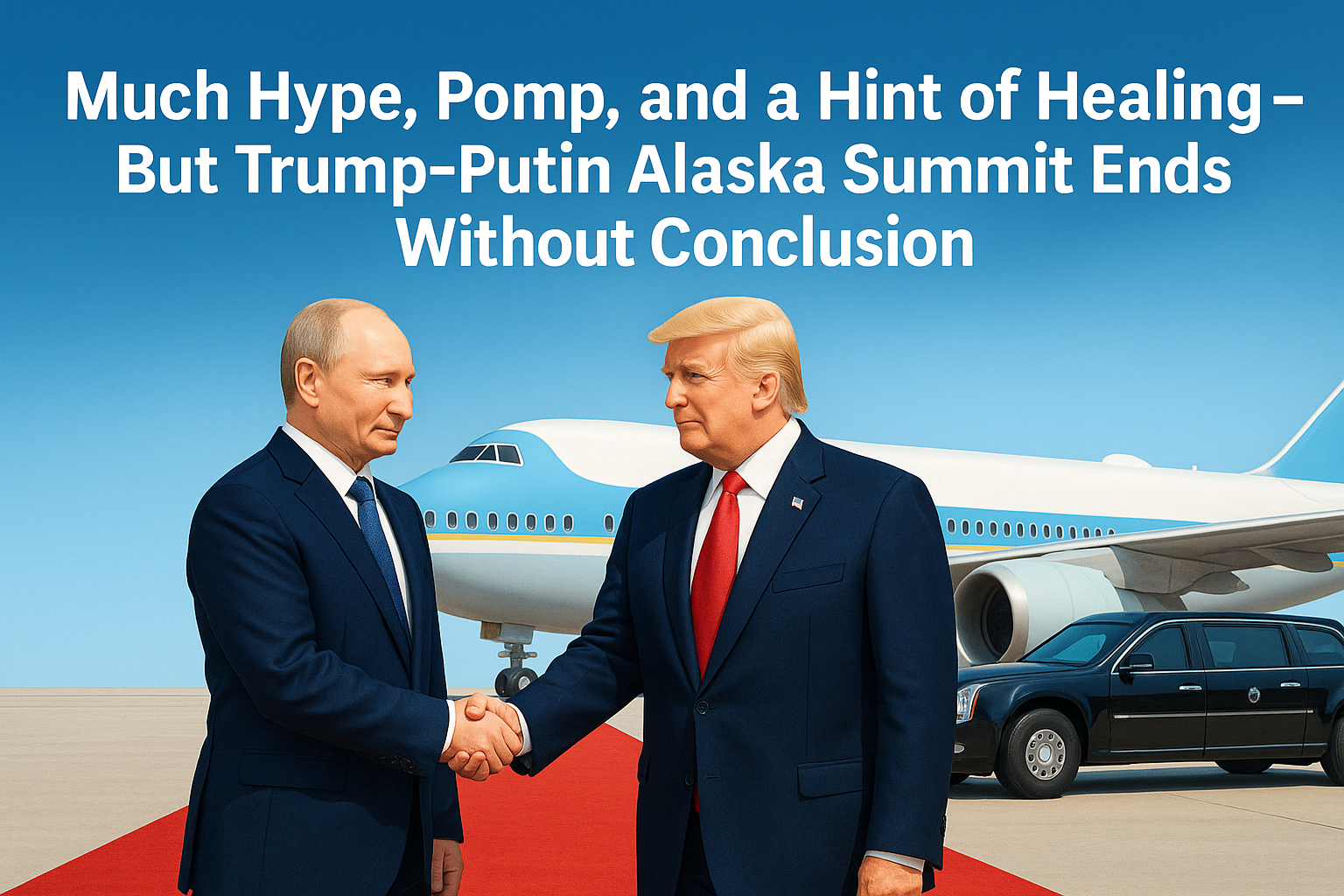
Trump and Putin met in Alaska with red carpets, military displays, and gestures of warmth. While the summit projected symbolic healing, no agreement on Ukraine emerged, leaving global observers cautious.
A Summit of Ceremony and Symbolism
Anchorage, Alaska, transformed into a stage of global spectacle on Friday as U.S. President Donald Trump welcomed Russian President Vladimir Putin to Joint Base Elmendorf-Richardson. From the moment Putin stepped onto American soil, the optics were unmistakable: a red carpet rolled out across the runway, military jets soaring overhead, and the iconic presidential limousine, The Beast, ready to carry both leaders.
The pageantry was deliberate. Trump greeted Putin with a firm handshake, then surprised observers by personally inviting the Russian leader into his armored limousine—a gesture interpreted as a symbol of trust, and perhaps of reconciliation. The setting suggested healing of strained ties, yet observers quickly noted that spectacle does not substitute substance.
Behind Closed Doors
The leaders met privately for about two to two-and-a-half hours in a format described as “three-on-three.” Trump was joined by Secretary of State Marco Rubio and special envoy Steve Witkoff, while Putin brought Foreign Minister Sergey Lavrov and senior aide Yuri Ushakov.
Insiders described the talks as “candid and respectful.” Both sides projected a tone of cautious optimism. Yet when the doors opened, no new path was unveiled.
No Breakthrough on Ukraine
In the post-meeting remarks, Trump called the summit “extremely productive” and even rated it “a 10.” Still, he acknowledged what many had already suspected: no agreement on Ukraine had been reached.
Putin echoed that the talks were constructive but offered no detail on concrete progress. Instead, he hinted at the possibility of hosting future discussions in Moscow, leaving the timeline open-ended.
For Ukraine, the absence of clarity was glaring. Officials in Kyiv voiced frustration at being sidelined in discussions that directly impact their nation.
Optics of Healing, But Questions Remain
Kremlin-released footage soon added to the theater. Clips showed Trump grasping Putin’s hands warmly, exchanging laughter, and escorting him into the presidential vehicle. Symbolism of reconciliation filled the airwaves, painting a picture of leaders intent on repairing fractured ties.
Yet critics cautioned that these images, however powerful, do not equate to real agreements. “Optics are not outcomes,” remarked one European diplomat.
Reactions at Home and Abroad
In Washington, Vice President Kamala Harris urged caution, warning against mistaking ceremony for results. Several lawmakers echoed that concern, emphasizing that American credibility relies on more than personal gestures.
In Europe, NATO allies expressed unease, watching a summit that appeared long on performance but short on deliverables. Diplomats described it as “a meeting that showcased pomp, but concluded with ambiguity.”
The Alaska Meeting in Context
This was the first in-person meeting between Trump and Putin since Trump’s return to office, making the Alaska summit a pivotal moment in U.S.-Russia relations. By hosting the event in America’s northern frontier, Trump sought to highlight both geography and symbolism: Alaska, a meeting ground between East and West.
Yet the outcome underlined a paradox. The summit showcased the highest levels of statecraft in spectacle—red carpets, flyovers, handshakes, limo rides—but failed to move forward on the most pressing issue: the Ukraine conflict.
Conclusion: Healing Without Resolution
The Trump-Putin meeting in Alaska will be remembered for its images—two powerful leaders shaking hands, smiling, and appearing side by side in a display of mutual respect. But history will also recall what it lacked: a concrete conclusion.
The symbolism suggested healing. The reality left the world waiting.
