
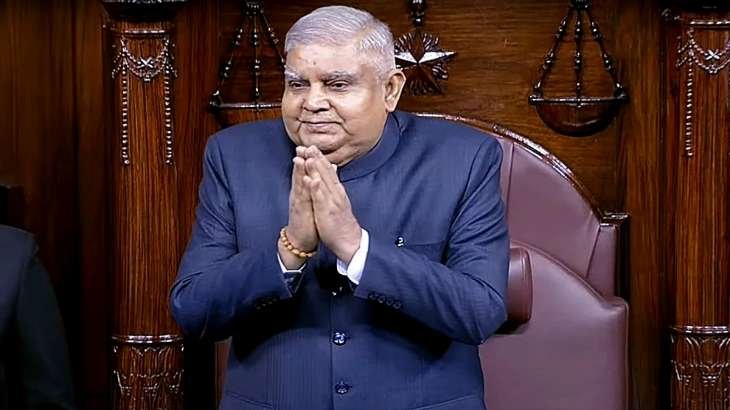
Vice-President Jagdeep Dhankhar’s sudden resignation has shaken India’s parliamentary fabric. Was it really about health, or power, pressure, and principle?
In India’s post-Independent political annals, Vice-President Jagdeep Dhankhar’s abrupt resignation on July 21, 2025, will not be remembered as a health-driven departure. It will be marked—perhaps mourned—as a symptom of something deeper: the unravelling balance between constitutional office, institutional duty, and executive ambition.
Though his letter cites health, let’s be clear—it was politics that proved fatal.
A Departure Unlike Any Other
Jagdeep Dhankhar didn’t express a desire to assume a higher office. He wasn’t elevated to the Presidency. He didn’t retire with applause.
He resigned mid-session, just hours after presiding over the Rajya Sabha as its Chair. His schedule for the week had already been publicly announced. His public demeanour showed no signs of frailty.
So what changed in a matter of hours?
A Flashpoint Named Justice
The friction between Dhankhar and the ruling regime had been simmering for months. But on July 21, it boiled over.
The Vice-President entertained motions against sitting judges—Justice Shekhar Kumar Yadav (Allahabad HC) and a Delhi HC judge, both under fire for controversial remarks and alleged misconduct. More importantly, Dhankhar refused to play ball with the government’s script for handling the judiciary, insisting instead onthe parliamentary process.
In doing so, he committed the cardinal sin in Indian politics today: defending institutional autonomy against executive convenience.
A Chair With a Spine
Dhankhar’s tenure was controversial. He questioned the ‘secular’ and ‘socialist’ pillars in the Constitution. He often echoed the RSS’s ideological calls. His confrontational tone with the judiciary made him both feared and admired.
Yet, ironically, when it came to procedural integrity, Dhankhar did not waver.
He acknowledged motions from the Opposition, verified signatures, and accepted their right to question judges—an act that set him on a collision course with his own political benefactors.
Between Parliament and Power
His final moments in office reflected a man torn—between the sanctity of his Chair and the gravity of party pressure.
As one BJP insider put it anonymously, “He had started behaving more like a constitutional authority and less like a party loyalist.” And in today’s political landscape, that’s a fireable offense, even if done voluntarily.
The Judiciary–Legislature Chessboard
By engaging directly with impeachment motions, Dhankhar inserted Parliament into a space traditionally tiptoed around. The government, fearing fallout and timing (especially with general elections inching closer), may have preferred deflection over accountability.
But Dhankhar, stubborn as he is principled, wouldn’t blink.
So instead, he bowed out—quietly, symbolically, strategically.
What We Lose With This Exit
Let’s not romanticize Dhankhar’s legacy. He was not without flaws. His handling of debates, his ideological outbursts, and his biases were often noted by Opposition parties and constitutional scholars alike.
But his exit is not just his. It’s ours.
We lose a constitutional office-bearer who—despite his baggage—chose to uphold Parliament over party, rules over rhetoric, and due process over directives.
That is rare.
And its loss, in an era of shrinking institutional space, is not just tragic—it’s historic.
FAQs
1. Why did Jagdeep Dhankhar resign suddenly?
While officially citing health, insiders and observers suggest increasing tension with the ruling government over judicial accountability and parliamentary procedures.
2. What triggered the final fallout?
His acceptance of Opposition-led impeachment motions against sitting judges, against the government’s preferred handling.
3. Was his resignation constitutional?
Yes, under Article 67(a) of the Constitution, any Vice-President may resign by writing to the President.
4. Is this the first such resignation?
No VP has resigned mid-term without a promotion to President. Dhankhar’s case is the first of its kind.
5. Who might replace him?
Nitish Kumar has emerged as a front-runner amid BJP overtures and Bihar caste calculus.
Please don’t forget to leave a review.
