
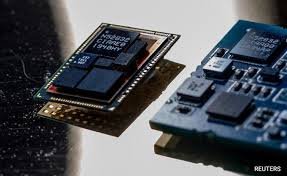
New Delhi (September 2, 2025): India on Tuesday unveiled its first fully indigenous 32-bit microprocessor, the ‘Vikram 3201’, developed by the Indian Space Research Organisation (ISRO). The launch marks a decisive leap for New Delhi’s ‘Aatmanirbhar Bharat’ mission and signals India’s ambition to compete with global semiconductor leaders such as Taiwan, South Korea, China, and the United States.
At a semiconductor industry event in Delhi, Prime Minister Narendra Modi hailed microchips as “digital diamonds” and stressed their strategic significance.
“If the last century was shaped by oil, this one is defined by the chip,” Modi said, urging global investors to see India as a key semiconductor hub.
A Microchip Built for the Stars
- The Vikram 3201 is a 32-bit processor with a custom instruction set architecture (ISA), an upgrade from the 16-bit ‘Vikram 1601’ ISRO has relied on since 2009.
- Designed for extreme conditions, it can operate between -55°C and 125°C, making it ideal for deep-space missions.
- It supports the Ada programming language, widely used in aerospace, satellite systems, and air traffic control due to its reliability.
This positions the chip not just as an achievement in space technology, but also as a template for civilian and commercial adoption.
Strategic and Economic Stakes
India’s semiconductor industry, currently worth $50 billion, is projected to cross $100 billion by 2030. Sources indicate that over $18 billion is already earmarked across 10 fabrication plants, supported by a $7 billion government investment through the India Semiconductor Mission.
Private players are also stepping up:
- Tata Electronics signed a $10 billion deal with Bosch for facilities in Assam and Gujarat.
- HCL-Foxconn announced a $433 million joint venture to build display driver chips in Uttar Pradesh.
- State-backed fabs are emerging in Andhra Pradesh, Odisha, and Punjab, the latter capable of producing 1.58 billion chips annually.
Why It Matters
- Self-Reliance: Local production reduces India’s dependence on imports from Taiwan and China.
- Supply Chain Security: After the pandemic exposed global fragility, India seeks to insulate its electronics sector from future shocks.
- Economic Impact: The sector is expected to generate 300,000 jobs by 2026 while boosting India’s $240 billion automotive and $18 billion consumer electronics industries.
- Strategic Leverage: With abundant minerals and rare gases, India is well-placed to secure raw materials vital for chip-making.
Looking Ahead
The ‘Vikram 3201’ demonstrates that India can not only design but also manufacture space-grade chips domestically—a critical milestone for space exploration, defense systems, and consumer tech ecosystems.
As Modi put it, the semiconductor race will define the future:
“The world is ready to build the semiconductor future with India.”
With ‘Vikram 3201,’ New Delhi has signaled that it intends to be more than just a participant in this global race—it aims to be a leader.
