
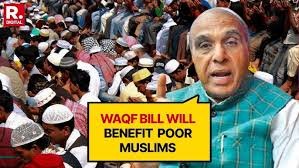
The ongoing debate surrounding the Waqf (Amendment) Bill has brought to the forefront serious allegations of systemic manipulation and misuse of Waqf properties, with critics claiming that politically influential and wealthy Muslims are exploiting these assets to the detriment of impoverished members of the community. Concerns are mounting over the potential for these practices to undermine the very purpose of Waqf, which is intended to provide charitable and religious benefits, particularly to the poor.
Reports and analyses highlight several key areas of concern:
- Political Interference:
- Appointments to Waqf boards are often influenced by political considerations, leading to individuals prioritizing personal or political agendas over the welfare of the community.
- Politically connected individuals are accused of engaging in land grabbing, illegally acquiring, or encroaching upon valuable Waqf properties through collusion and legal loopholes.
- Favoritism and patronage are alleged to result in the unequal distribution of Waqf resources, with the most vulnerable and impoverished Muslims being marginalized.
- Financial Mismanagement and Corruption:
- Allegations of corruption, including embezzlement and misappropriation of funds, plague some Waqf boards, raising questions about accountability.
- A lack of transparency in accounting practices and limited public oversight create opportunities for financial irregularities and abuse.
- The commercialization of valuable Waqf properties, with profits not reaching the intended beneficiaries, is a major point of contention.
- The returns from waqf properties are often very low, and they are not used in a manner that would greatly benefit the poor.
- Deprivation of Impoverished Muslims:
- The benefits derived from Waqf properties are not always distributed equitably, leaving the most marginalized and impoverished Muslims without access to their rightful share.
- Poor Muslims often lack the resources or knowledge to navigate the complex legal and administrative processes required to access Waqf benefits.
- Exploitation by those managing Waqf properties, including unfair lease agreements and other forms of manipulation, is a serious concern.
- Legal Complexities:
- Ambiguous laws and complex legal battles have often allowed for loopholes to be exploited.
- Lengthy legal processes, which the poor often can not afford, serve as a barrier to justice.
The debate surrounding the Waqf Bill and related issues has intensified, with calls for reform to ensure transparency, accountability, and equitable distribution of Waqf resources. The focus is on safeguarding these assets for the intended beneficiaries, particularly poor Muslims, and preventing their exploitation by powerful individuals.
Property held by Waqf in India and what is the income from those properties :
- Property Holdings:
- Waqf boards in India manage a substantial amount of property. Reports indicate they control approximately 872,000 properties, spanning around 940,000 acres of land.
- This makes Waqf boards significant landowners in India, often cited as one of the largest, following the Indian Railways and defense forces.
- Estimated Value:
- The estimated value of these Waqf properties is around Rs.1.2 lakh crore (approximately $14.22 billion).
- Income and Management:
- However, there are widespread concerns regarding the effective management and utilization of these properties.
- Issues like encroachment, illegal occupation, and lack of transparency in financial transactions are frequently reported.
- The income generated from these properties is often not optimized, and there are concerns that the benefits do not always reach the intended beneficiaries, particularly poor Muslims.
- There are also many legal disputes surrounding waqf properties that greatly reduce the income that could be generated.
What is the purpose of Waqf?
Intended Purpose:
- Waqf properties are intended to serve charitable and religious purposes, with a significant focus on benefiting the poor and disadvantaged within the Muslim community. This includes providing support for:
- Education
- Healthcare
- Poverty alleviation
- Religious institutions
Challenges and Concerns:
- Mismanagement and Corruption:
- Reports of mismanagement, corruption, and encroachment on Waqf properties raise concerns about whether the intended beneficiaries are receiving their due share.
- If Waqf properties are not managed effectively, the potential benefits for poor Muslims are diminished.
- Lack of Transparency:
- A lack of transparency in the management of Waqf properties can hinder accountability and make it difficult to ensure that resources are reaching those who need them most.
- Unequal Distribution:
- There are concerns that the benefits of Waqf properties are not always distributed equitably, with some individuals or groups receiving preferential treatment.
- This can leave the most vulnerable and impoverished Muslims marginalized.
- Legal complexities:
- The legal battles and ambiguous laws surrounding waqf properties can make it difficult for poor muslims to receive their due benefits.
Arguments for Reform:
- Proponents of the Waqf (Amendment) Bill argue that reforms are necessary to address these challenges and ensure that Waqf properties are managed effectively for the benefit of poor Muslims.
- They emphasize the need for greater transparency, accountability, and legal mechanisms to reclaim illegally occupied properties.
In summary:
- While Waqf properties have the potential to significantly benefit poor Muslims, there are concerns that mismanagement and corruption are hindering this potential.
- The ongoing debate surrounding the Waqf Bill reflects the need for reforms to ensure that these properties are managed in a way that truly benefits the intended beneficiaries.
