
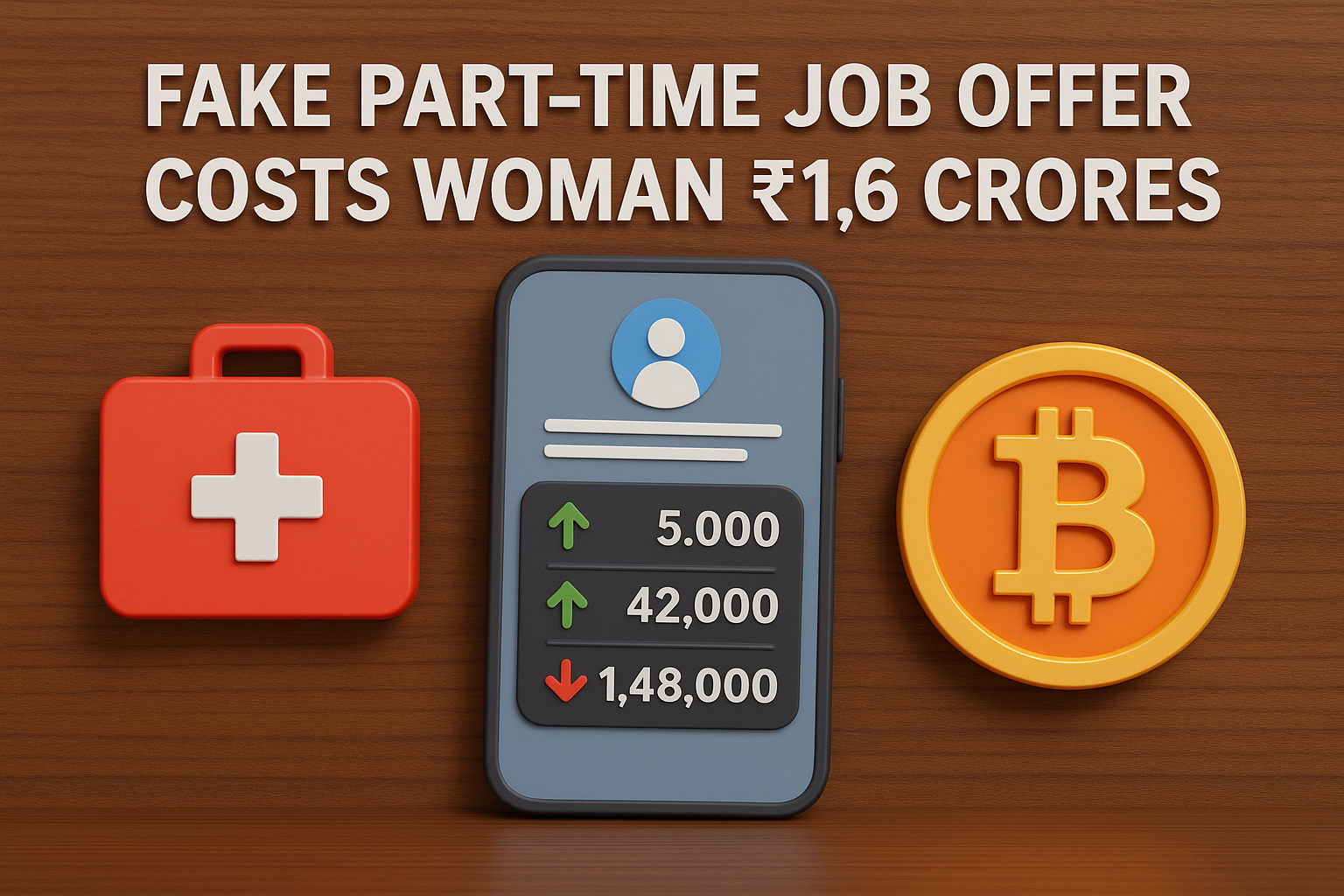
A Hyderabad woman lost Rs 1.6 crores to a fake part-time job scam involving Telegram and cryptocurrency. Learn how the fraud unfolded and key tips to stay safe from online scams.
What began as a simple message on WhatsApp turned into a financial nightmare for 54-year-old Rekha (name changed), a housewife from Hyderabad. It all started on June 2, with an offer too innocent to raise alarm: a part-time opportunity rating hotels via Telegram. No pressure, no complexity—just a few taps on her phone. And like many before her, Rekha took the bait.
To build trust, the scammers lured her with an “economic task” requiring a Rs2,000 investment. The prompt return of Rs2,800 made it all feel real. Trust was planted—and quickly exploited.
Encouraged to invest more for higher returns, Rekha found herself paying Rs 5,000, then Rs 42,000, and soon Rs 1.48 lakh. Each time, she was reassured of massive gains, but the returns never came. Instead, the stakes kept rising.
From that point on, the scam escalated into a psychological maze. The fraudsters claimed she’d made “errors” in transactions. The only fix? More money. She paid Rs 2.98 lakh to unlock her “blocked” funds. Then came Rs6 lakh to “boost her credit score,” and Rs11.69 lakh for another “correction.” They even made her believe she had to pay Rs 8.51 lakh as a “tax” and Rs 37.24 lakh to “upgrade” her account.
Each promise of recovery dangled hope like a carrot. And just when she thought she was at the end, the scammers hit her with the final blow—Rs 50 lakh to “fix” a mistake, and Rs 45 lakh in “service charges.”
Rekha gave everything—her savings, her trust, her peace of mind. When it finally dawned on her that she had been duped, she was Rs 1.61 crore poorer.
She reported the fraud to Hyderabad Cybercrime police, but the psychological toll lingers. This wasn’t just about money—it was about how easily trust can be weaponized in the digital age.
A Wake-Up Call for Everyone
Cybercrime today doesn’t always look like a hacker behind a screen. Sometimes, it looks like a friendly message, a helpful guide, a “limited-time” offer. These fraudsters aren’t just coders—they’re behavioral manipulators.
Key Lessons:
- Always verify online job offers through official channels.
- Be cautious of any scheme that requires upfront payment for returns.
- If you’re being rushed or pressured to pay again and again—it’s a scam.
- Talk to family members, especially elders, about digital fraud prevention.
Let Rekha’s story be more than a cautionary tale—let it be a call to stay informed, alert, and skeptical in the face of easy promises.
Want to raise awareness? Share this story. Talk about it. Let’s make it harder for scammers to find their next victim.
#CyberScam #OnlineFraud #Hyderabad #DigitalAwareness #CryptoScams #OnlineJobs #TelegramFraud #CyberSecurityIndia
