
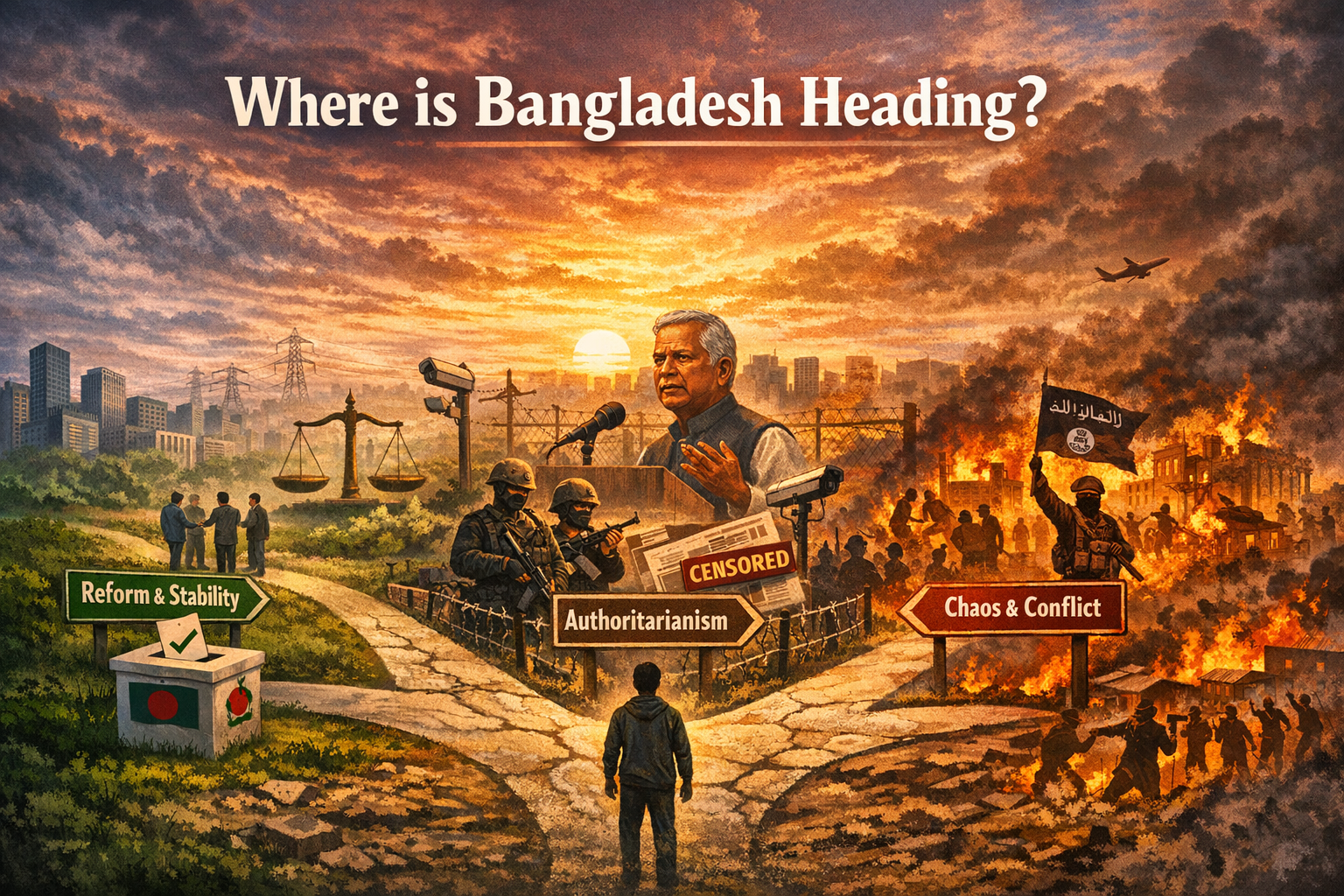
Bangladesh is standing at a fork in the road, and the direction it takes will depend less on slogans and more on institutions.
For decades, Bangladesh’s trajectory was relatively clear: economic growth driven by garments and remittances, a strong—if controversial—centralised state, and a balancing act between secular nationalism and religious politics. That equilibrium has now cracked.
What we are seeing today is not one crisis, but several converging crises.
First, there is a legitimacy crisis. After the fall of an elected government and the rise of an interim arrangement under Muhammad Yunus, many citizens feel politically unanchored. Interim governments are, by nature, temporary. When “temporary” stretches on, trust erodes. Power without a clear electoral horizon invites street politics.
Second, there is an identity crisis. Bangladesh was born in 1971 on linguistic nationalism and secular ideals. Today, that founding logic is being openly challenged. Attacks on minorities, intimidation of journalists, and slogans rooted in religious absolutism suggest a struggle over what kind of state Bangladesh wants to be:
a civic republic—or a majoritarian one.
Third, there is an economic pressure cooker. Inflation, currency stress, job insecurity, and declining foreign confidence are not abstract numbers. They are daily humiliations. Historically, when livelihoods collapse, ideology radicalises. Economic despair becomes fuel for political extremism.
Fourth, there is a geopolitical squeeze. Bangladesh is no longer operating in a quiet neighbourhood. India, China, the US, and Gulf actors all have stakes. When domestic institutions weaken, external influence grows. Sovereignty quietly leaks before anyone notices.
So where is Bangladesh heading?
Three paths are visible:
One path leads to stabilisation through reform: credible elections, minority protection, rule of law, and depoliticised security forces. This path is difficult but possible.
Another leads to managed authoritarianism, where order is restored but dissent is suppressed, media shrinks, and fear replaces consent. This path offers short-term calm and long-term decay.
The third path—most dangerous—leads to societal fracture: normalised mob violence, religious vigilantism, capital flight, brain drain, and permanent instability. States don’t collapse overnight; they hollow out.
Bangladesh is not doomed. It has resilient people, a history of resistance, and enormous human capital. But history is unforgiving: nations that abandon pluralism and delay accountability rarely get a second warning.
This moment will decide whether Bangladesh emerges as a repaired republic or slides into a contested state—one protest, one silence, one compromise at a time.
